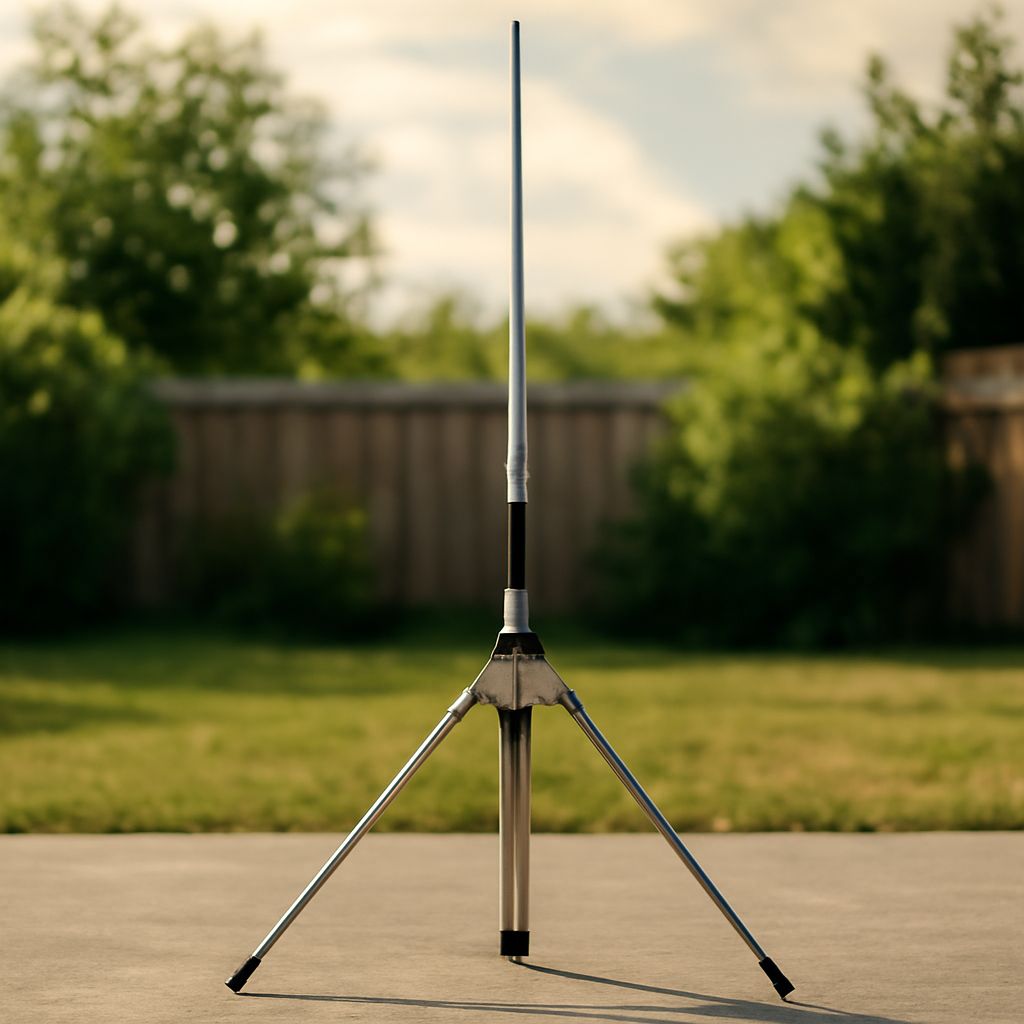
Choose an antenna designed for the CB band that fits your available space, mounting position, and cable route. For local contacts in several directions, a vertical antenna for a CB base station is often a practical choice. Match the fixed CB radio station’s antenna to its surroundings, then check its tuning after installation.
CB Radio Base Station Antenna Options
CB operates near 27 MHz. A full-size quarter-wave radiator is roughly nine feet long, while a half-wave is roughly eighteen feet before construction details and tuning adjustments. The actual dimensions depend on the design. A CB radio base station antenna can be a vertical, a wire dipole, or a directional beam; each needs a different amount of room and support.
A quarter-wave vertical commonly uses horizontal or sloping radial elements as a counterpoise, the conducting structure that completes its radio-frequency system. Allow space for those radials as well as the upright element. A half-wave vertical antenna for a CB radio base may use a matching network and different counterpoise requirements. Follow the particular manufacturer’s instructions rather than removing supplied parts to make it fit.
A vertical base CB antenna generally covers directions around the mast and suits local conversations with stations scattered around you. Many mobile CB antennas are vertical too, so matching their polarization—the orientation of the electric field—can help a local signal. A horizontal dipole needs two supported ends and can have a different directional pattern. A beam concentrates energy in selected directions but needs more space, a sturdy support, and often a rotator.
A CB radio base antenna belongs to the CB band; a GMRS antenna is designed for a much higher frequency and is not a substitute. A mobile whip designed to work against a vehicle body also needs its specified ground plane or an appropriate base conversion. A fixed installation should provide the mounting and counterpoise its chosen antenna actually requires.
Height, clearance, and safe support
Elevating the fixed CB antenna can clear nearby obstructions and improve the path to other stations. Trees, buildings, terrain, and nearby metal still affect the result. First look for a clear, accessible mounting location with a suitable route to the radio. A slightly lower installation with a short cable and a solid mount can be more practical than a taller one requiring a long, exposed run.
Keep the antenna, mast, guy wires, and all parts of the installation well away from overhead electrical lines, including anywhere they could reach if they fall. The ARRL’s antenna safety guidance discusses these hazards. Never install during a storm or work on a transmitting antenna. Use a qualified installer when the site, roof work, grounding, or electrical clearances are uncertain.
Check local rules and the current FCC requirements for CB antenna height and installation before choosing a mast. Plan mechanical support for wind, weather, and the manufacturer’s specified mounting arrangement. Bonding, grounding, and lightning protection need to follow applicable electrical codes and the building’s grounding system; a mast driven into soil alone is not a complete protection plan.
Compare gain with the installation
Gain describes how an antenna directs energy relative to a stated reference, often an isotropic radiator (dBi) or a dipole (dBd). It does not create extra transmitter power. A higher-gain vertical can direct more energy toward some angles and less toward others; the actual pattern depends on the antenna and its surroundings. Compare claims using the same reference and look for a published pattern and measurement conditions.
For a home CB station’s antenna, the useful question is whether that pattern serves the stations you want to reach from the height you can safely install. A CB base station antenna with a clear path and sound cable connections may outperform a more ambitious one compromised by its mounting location. Similarly, a directional antenna can help in one direction but makes less sense if your contacts are distributed around the compass.
Feed line and tuning
The feed line carries radio-frequency power between the radio and its stationary CB antenna. Most stations use 50-ohm coaxial cable. Choose cable with published loss at approximately 27 MHz, then estimate the loss for the actual run length; keep the run reasonably short without pulling it tight. Use compatible connectors, protect outdoor joints from water, and provide a drip loop and strain relief. Moisture or a poor connection can spoil an otherwise good installation.
After mounting a CB base station antenna in its intended position, measure standing wave ratio (SWR), a measure of the match between the feed line and antenna system. Connect a suitable SWR meter as directed and check the low, middle, and high CB channels at the radio’s permitted power. Follow the antenna maker’s adjustment procedure; stop transmitting if readings are high and inspect the cable and connections. A low reading indicates a good match at the measuring point, not a complete measurement of radiation performance. The ARRL’s feed-line overview explains why a tuner at the radio does not remove mismatch elsewhere on the line.
For a compact lot with all-around local coverage, consider a vertical CB base radio antenna whose height and radials fit safely. If you have room for supports, compare a dipole; for a consistent distant direction, consider a beam and its mounting requirements. Choose the fixed CB radio antenna that fits the clearances and cable route you can actually provide, then verify its SWR after installation.