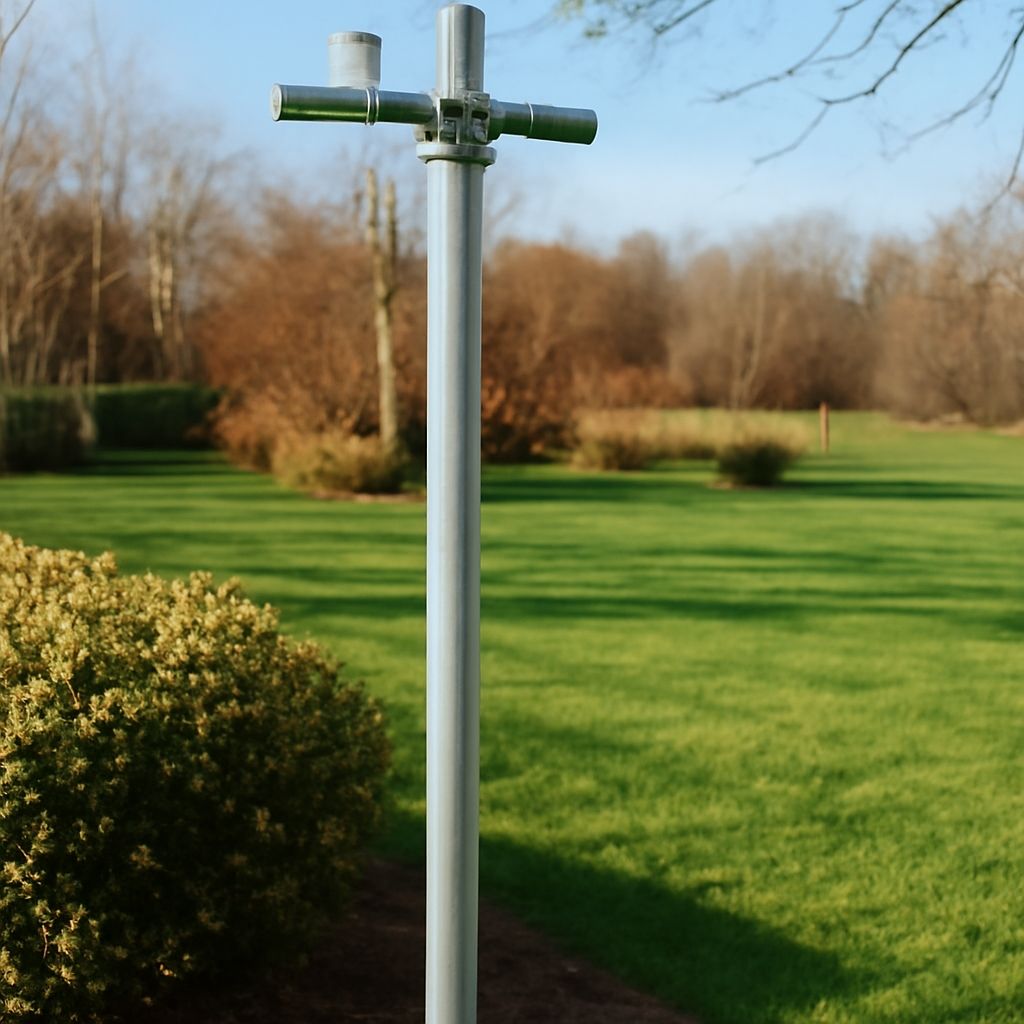
A push up antenna mast is suitable for a light antenna when its unsupported height, wind exposure, and mounting surface are modest. The right choice is not simply the largest pipe: match the mast and brackets to the antenna’s projected wind area, total weight, height above the last support, and local exposure. Keep the top section within the manufacturer’s limit and use more support rather than adding unsupported length.
A reachable wall or eave installation can be a reasonable DIY project if you can work from a stable ladder, attach to sound framing, and route coax without tension. A steep roof, chimney, tall mast, guy wires, electrical hazards, or structural repairs shifts the job toward a professional.
How much can a push-up antenna mast support safely?
Support is governed by bending leverage, not weight alone. Wind acts on the antenna’s projected area and creates torque at the upper bracket. A large, high antenna can overload a short mast in gusts, while a light antenna can become a problem when the pipe extends far above its last support.
Check these inputs before choosing hardware:
- Wind area: Use the antenna’s projected area, including reflectors and solid panels, rather than weight alone.
- Leverage: The higher the antenna sits above the upper bracket, the more force reaches the mounting points.
- Unsupported height: Account for the section above the top support and the distance between brackets.
- Materials: Consider pipe material, wall thickness, joint design, corrosion, and the condition of the framing or masonry.
Use two properly spaced brackets or a rated tripod, and attach them to structure that can carry the load. Wall supports are often spaced about 3 to 5 feet apart, subject to the bracket and mast instructions. Minimize unsupported height above the top bracket. Corrosion, crushed tubing, loose straps, and rotten wood reduce capacity.
Secure coax below the antenna so its weight does not pull on the connector. Leave a drip loop, allow gentle bends, and fasten the cable to the mast or structure; a dangling or taut cable adds strain in wind.
How do you choose a TV antenna mast pipe?
Choose a TV antenna mast pipe by its complete specification, not diameter alone. Common residential galvanized steel sections use roughly 1-1/4-, 1-1/2-, or 2-inch nominal or actual diameters, depending on the product. Five- and 10-foot sections are common, but section length does not establish a safe unsupported span.
Do not judge mast strength from outside diameter alone. Material, wall thickness, unsupported length, antenna load, joint design, and corrosion all matter. A narrow, thick-wall steel tube can outperform a larger thin-wall tube, but manufacturer load data or a qualified calculation is needed to establish suitability.
Select the pipe and fittings in this order:
- Record the antenna, rotor, preamplifier, and accessory weights, plus the manufacturer’s wind-area rating.
- Measure the required height and identify how much pipe will extend above the highest bracket.
- Choose a pipe and mount rated for that load, span, and exposure rather than combining unrelated components.
- Inspect every joint, clamp, and fastener, and replace any part showing rust pitting, deformation, or damaged threads.
Galvanized steel is common for residential masts because it resists weather and is widely supported by standard brackets. Use corrosion-resistant fasteners, compatible metals, and caps or sealant where appropriate. If the antenna requires a long extension, a rotor, or guy wires, treat the assembly as a structural system rather than a simple pipe.
Which mounting location fits the structure and access?
Compare the mounting location before buying the mast:
- Wall or eave: Usually the simplest option when two brackets can reach solid studs, blocking, or sound masonry. It offers relatively easy installation and future service access.
- Chimney: Chimney straps avoid roof penetrations, but the masonry and mortar must be sound. Elevated access is more difficult, and straps must not damage the flue or loosen under movement.
- Roof: A tripod or roof bracket can provide height, but it may require rafter attachment, careful flashing, or a rated nonpenetrating system. Steep slopes and weather sealing increase the risk.
- Ground: A ground mast allows substantial height but may need concrete, guy wires, excavation, and a clear cable route. It is structurally and electrically more involved than a short wall mount.
When should you call a TV antenna installer?
Call a TV antenna installer when the antenna will be high above the roof, the roof is steep or fragile, the chimney or framing is questionable, or the design needs guy wires, a rotor, a heavy antenna, or structural reinforcement. Do not work near overhead power lines. Professional help is also sensible when safe ladder positioning, roof access, cable routing, or weather sealing is uncertain.
Give the installer practical information before the visit:
- The channels or network stations you need, and any reception problems you already experience.
- The property location, nearby obstructions, terrain, trees, and the proposed antenna height.
- The antenna model or approximate wind area and weight, including any amplifier or rotor.
- The preferred mounting surface—wall, chimney, roof, or ground—and its visible condition.
- Every TV location, cable entry point, splitter, attic route, and the distance or obstacles along the coax path.
Photos of the roofline, chimney, mounting wall, utility lines, and intended cable route help the installer judge access and prepare the correct brackets, pipe, fasteners, and safety equipment.