A high gain tv antenna improves reception mainly by concentrating sensitivity toward a station, not by receiving every direction more strongly. Pair that antenna with a rigid, appropriately sized tv antenna mast pole: extra height helps only when the structure can resist wind and keep the antenna aimed.
Use local station bearings and band assignments to decide whether to buy a directional antenna or build one. Then compare channel scans at several headings and heights before permanently tightening the mount. This process helps identify whether the problem is antenna design, aiming, cable loss, or an overloaded mast.
What Does a High-Gain TV Antenna Actually Improve?
Gain describes how strongly an antenna receives in a preferred direction compared with a reference antenna. A high gain tv antenna usually achieves that gain through directionality: its elements and reflector focus reception into a narrower beamwidth. It can pull in a weaker station from that bearing, but it will not necessarily improve stations located behind or far to the side.
Frequency band matters just as much. UHF antennas use shorter elements and commonly cover modern broadcast channels in the upper-frequency range. VHF-high stations require longer elements, and a UHF-only design may miss them even if its advertised gain is impressive. Check the real RF channel assignments for local stations rather than relying only on their virtual channel numbers.
Map each station’s compass bearing from the installation site. If most stations cluster within a narrow arc, a directional antenna can provide useful gain. If stations are widely separated, a broader antenna, a rotator, or separate antennas may perform better. A large mileage claim or gain number is not proof of better reception in every direction; multipath reflections, trees, terrain, and overloaded amplifiers can still cause pixelation.
How to Make a Homemade TV Antenna for Local Channels
If you are learning how to make a homemade tv antenna, begin with the local channel list rather than copying a random design. A simple UHF bow-tie or half-wave dipole can work for nearby stations when its element dimensions match the target frequencies. It is a practical experiment, but it will not automatically equal a commercial high-gain model.
- Find the center frequency of the channels you need. For a quarter-wave element, a useful starting dimension in inches is 2952 divided by the frequency in MHz. At 600 MHz, that is about 4.9 inches per arm.
- Form two straight or triangular copper-wire arms for a bow-tie, leaving a small feed gap between the inner ends. Use a rigid, nonconductive board to keep the spacing stable.
- Attach the two conductors to a 75-ohm-to-300-ohm matching transformer, then connect the transformer to RG6 coaxial cable. Keep the connection sheltered from water.
- For more UHF gain, add a conductive reflector behind the elements with a consistent air gap. Build dimensions around the channel group, because a reflector and tightly spaced elements can narrow the useful band.
VHF elements need to be substantially longer, so add a separate VHF dipole or choose a combination antenna if local stations use both bands. Test the homemade antenna near a window first, but treat that result as preliminary: indoor walls and nearby metal can change the signal substantially outdoors.
How Should a TV Antenna Mast Pole Support the Antenna?
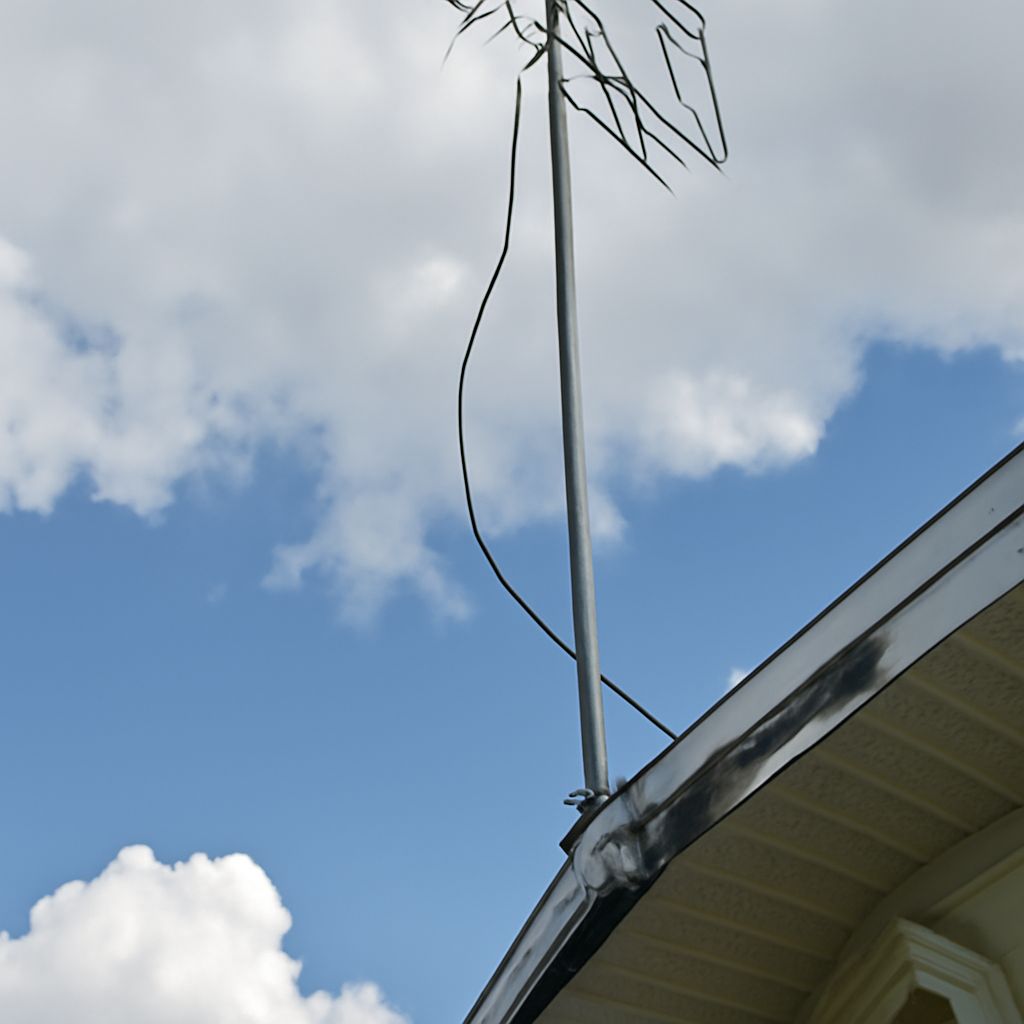
Select the mast from the antenna’s projected wind area, weight, mounting height, and exposure, not from antenna gain alone. For one compact residential antenna, a galvanized steel mast around 1.25 to 2 inches in diameter is a common starting range, provided the antenna clamp and brackets are made for that diameter. Follow the mast and antenna manufacturers’ wind-load limits when the antenna has a large reflector or sits in an exposed location.
Keep the unsupported section short. About 5 to 6 feet is a conservative starting point for a small roof or eave installation; a taller extension needs a mast rated for the combined bending load and may require guy wires or an engineered mount. Wind force increases with projected area, and the bending leverage increases as the antenna moves farther above the upper bracket.
- Use two wall or eave brackets with several feet of vertical separation when the structure allows it.
- Use a roof tripod or a properly sealed roof mount when wall brackets cannot carry the load.
- Use galvanized fasteners, tighten every clamp against clean metal, and do not let the antenna rest against the mast or roof.
- Route UV-resistant RG6 down the mast with loose weatherproof straps. Leave a small service loop at the antenna, avoid sharp bends, and form a downward drip loop before the cable enters the building.
The best tv antenna masts are rigid enough to prevent aiming changes during gusts. Bond the coax grounding block and metal mast to the building’s approved grounding system, following local electrical requirements.
How Do You Aim, Secure, and Test TV Antenna Masts?
Make the first test repeatable. Use the same television, cable, amplifier setting, and approximate time for every comparison. A signal-strength reading is useful, but signal quality, stable decoding, and the absence of dropouts are better success measures.
- Write down each station’s bearing and identify the strongest station group. Point the antenna toward the center of that group, with the elements in the recommended horizontal or vertical orientation.
- Run a complete channel scan and record every desired channel, its signal quality, and any pixelation or audio breaks.
- Rotate the antenna 10 to 15 degrees at a time. Pause briefly at each heading, repeat the scan or inspect the tuner’s signal screen, and mark the heading with the best combined quality and channel count.
- If reception remains weak, raise the antenna in 2- or 3-foot increments and repeat the same comparison. Stop when quality no longer improves, because extra height adds wind load without guaranteed benefit.
- Once the best position is clear, tighten the antenna clamp and mast brackets, rescan, and watch the weakest important channel for several minutes. Secure the coax so its weight cannot twist the antenna.
If one heading favors UHF while another favors VHF, or stations remain unreliable at every height, the limitation is probably band coverage, terrain, or multipath rather than mast height. If the mast moves in wind, correct the support before fine-tuning the aim.