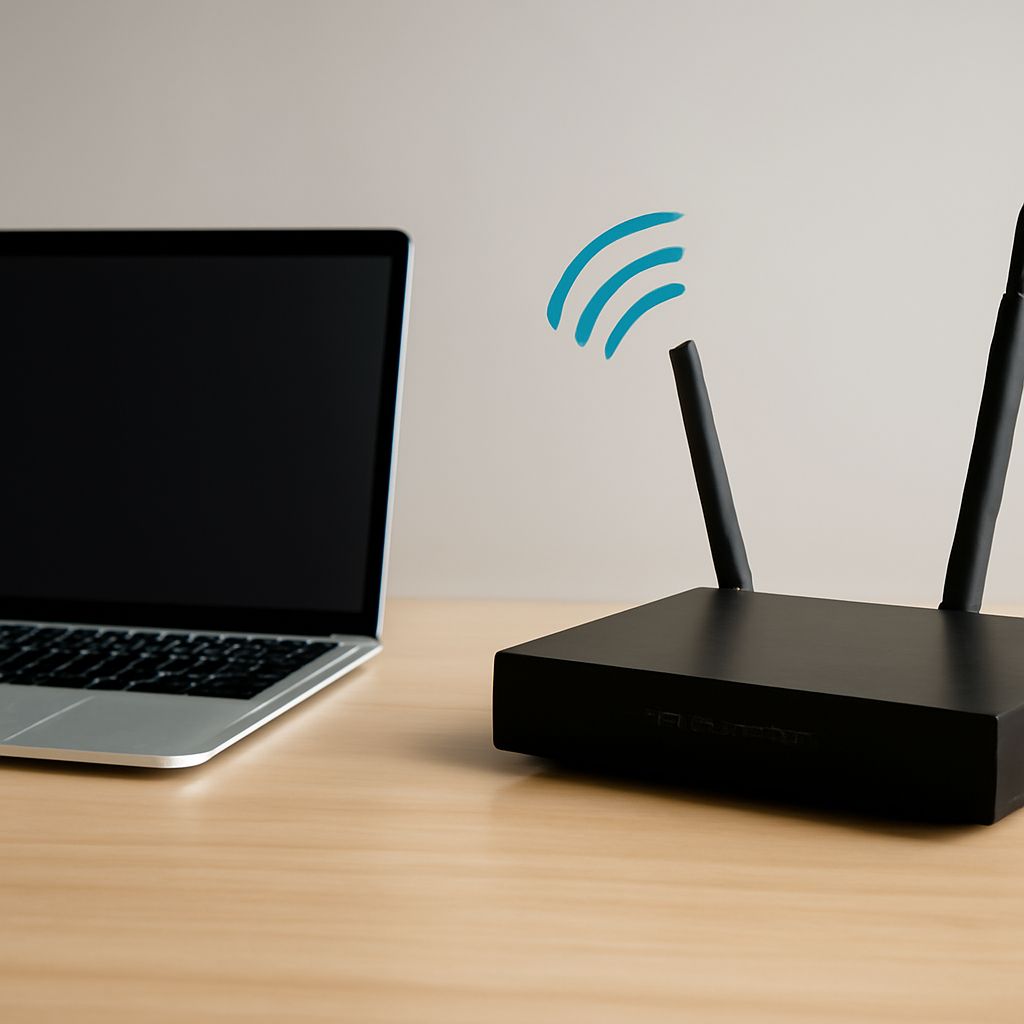
An Ethernet access point adds Wi-Fi to a network that already has a router. It connects to the router over an Ethernet cable, then provides wireless access without becoming a second router. This is useful when the existing router handles internet access well but its Wi-Fi signal does not reach every room.
The key is to separate four functions: the DSL modem connects to the service line, the router directs traffic between networks, the Ethernet switch connects wired devices, and the access point connects wireless devices. One home gateway may contain all four.
How does an Ethernet access point add Wi-Fi?
Connect the access point’s Ethernet uplink to a LAN port on the router or on a switch connected to that router. The access point then bridges wireless clients to the same local network as wired clients.
Separate access-point layout: Internet → router → Ethernet switch or LAN port → Ethernet access point → Wi-Fi devices
Configure the access point in access-point or bridge mode when that option exists. In this mode, the main router normally provides DHCP, which assigns local IP addresses, and NAT, which translates private local addresses for internet traffic. The access point should not run a second DHCP server or perform a second layer of NAT.
Give the access point a management address so you can open its settings later. That address can be assigned by the main router through a reserved DHCP lease or configured as a suitable fixed address outside the router’s automatic assignment range. The address is for administration; it does not make the access point a router.
You can use the same SSID, password, and security method on multiple access points to make moving around easier. Each access point still needs sensible channel planning. On 2.4 GHz, neighboring access points should use non-overlapping channels where possible. The access points own their radio channels; the router does not automatically control every separate AP’s channel unless a managed Wi-Fi system coordinates them.
What are the four roles inside a home network?
- DSL modem: Converts the signal on a DSL telephone line into Ethernet traffic. It handles the connection to the DSL provider but does not inherently provide Wi-Fi, local DHCP, or NAT.
- Router: Connects different networks, especially your private LAN and the internet. It commonly performs NAT, runs DHCP, applies firewall rules, and chooses where IP packets should go.
- Ethernet switch: Provides multiple wired LAN ports and forwards local Ethernet frames between them. A basic switch does not assign IP addresses, perform NAT, or create Wi-Fi.
- Wireless access point: Provides a wireless network and bridges Wi-Fi clients to the wired LAN. It advertises an SSID, handles wireless authentication, and uses one or more radio channels.
These are functions, not necessarily separate boxes. A home gateway may contain a modem, router, four-port switch, and wireless access point. An independent switch may add more Ethernet ports, while an independent AP may add Wi-Fi in a distant part of the building.
What does the wireless router radio control?
The wireless router radio is the Wi-Fi part built into a router. It transmits and receives radio signals, advertises the SSID, negotiates connections with clients, applies wireless security, and uses selected bands and channels. Its coverage and capacity depend on factors such as antenna design, interference, channel width, and client distance.
The radio does not replace the router’s wired functions. If Wi-Fi is disabled, the device can usually continue routing Ethernet traffic, providing DHCP, performing NAT, and serving its LAN switch ports. Disabling the radio removes wireless service; it does not disable wired routing.
A separate Ethernet access point has its own radio and channel settings. The router’s built-in radio and the separate AP can use the same SSID for a shared network or different SSIDs to identify locations, guest access, or different policies.
How does a wireless DSL modem router combine roles, and what should you add?
A device sold as a wireless DSL modem router combines the upstream DSL modem with the local router, Ethernet switch, and wireless access point:
Combined gateway layout: DSL line → modem function → router function → built-in Ethernet switch → built-in wireless radio → wired and Wi-Fi devices
In this arrangement, the gateway usually owns DHCP, NAT, the LAN management address, and the built-in Wi-Fi settings. Its LAN ports connect wired devices, while its wireless radio connects Wi-Fi clients. You do not need another router merely to add coverage.
Add an Ethernet access point when the gateway’s Wi-Fi does not cover the building or cannot support the required client load. Connect the AP to a gateway LAN port, select AP or bridge mode, and leave DHCP and NAT on the gateway. Add an Ethernet switch instead when the problem is a shortage of wired ports. Add a separate router only when you need a distinct routed network; otherwise, it can create double NAT and duplicate DHCP.