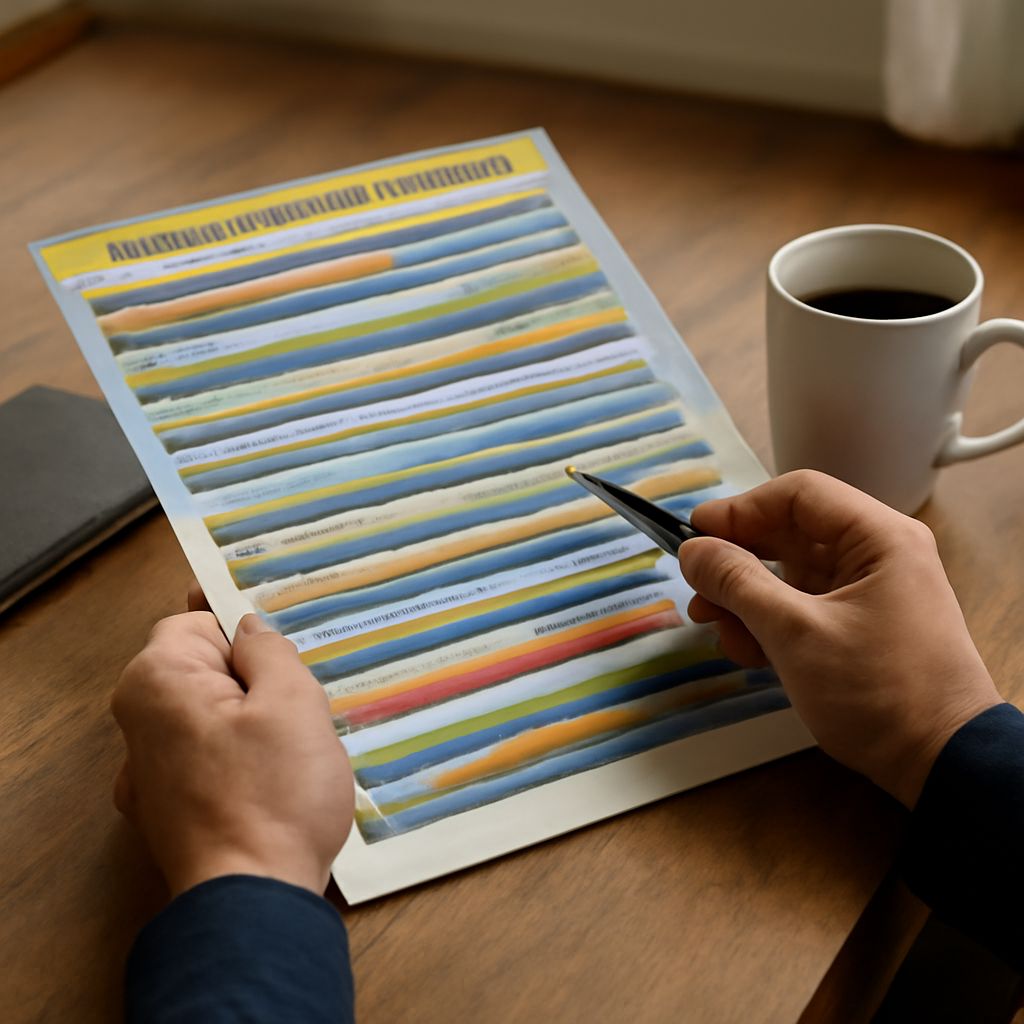
This ham radio bands chart matches major amateur bands with their typical frequencies, modes, and propagation. Use it as a starting reference, then select equipment that covers the band and mode you actually plan to use.
The best beginner setup is not a universal package. A 2-meter FM handheld suits local repeaters, while a 20-meter SSB station needs an HF transceiver, different antenna, feed line, and power supply.
How to Read a Ham Radio Bands Chart: Frequencies, Modes, and Propagation
These are representative U.S. allocations. Band edges, permitted modes, and power limits vary by country and license class, so use the applicable band plan before transmitting.
- 160 meters: 1.800–2.000 MHz; CW, data, and SSB. Mostly a nighttime band for regional and long-distance contacts.
- 80 meters: 3.500–4.000 MHz; CW, data, and SSB. Useful for regional communication, especially after dark.
- 60 meters: 5.3305–5.4064 MHz in the U.S.; channelized voice and data. Often supports reliable regional coverage.
- 40 meters: 7.000–7.300 MHz; CW, data, and SSB. A versatile band for regional and worldwide contacts by day or night.
- 30 meters: 10.100–10.150 MHz; mainly CW and data. Its narrow allocation favors digital and Morse contacts rather than voice.
- 20 meters: 14.000–14.350 MHz; CW, data, and SSB. One of the most useful daytime bands for long-distance contacts.
- 17 and 15 meters: 18.068–18.168 and 21.000–21.450 MHz; CW, data, and SSB. They favor daytime paths when solar conditions cooperate.
- 12 and 10 meters: 24.890–24.990 and 28.000–29.700 MHz; CW, data, SSB, and FM where permitted. They can be quiet, local, or surprisingly long-range during openings.
- 6 meters: 50–54 MHz; FM, SSB, CW, and data. Normally local or line-of-sight, with occasional distant sporadic-E openings.
- 2 meters: 144–148 MHz; primarily FM, plus SSB and data. The main entry band for local repeaters and simplex.
- 70 centimeters: 420–450 MHz in much of the U.S.; FM, SSB, and data. Common for repeaters, short-range contacts, and compact antennas.
A band describes a frequency range; it does not identify the operating mode. Always check the local band plan for recommended calling frequencies and mode segments.
Ham Radio Cheat Sheet: Band, Mode, Propagation, and Equipment Terms
- Mode: FM is common for local VHF/UHF voice. SSB, CW, and digital modes are common on HF and use different radio controls and bandwidth.
- Propagation: Line-of-sight dominates VHF/UHF. HF signals can reflect through the ionosphere, with results changing by frequency, time, season, and solar activity.
- Transceiver coverage: A 2-meter/70-centimeter handheld usually does not transmit on HF. An HF radio covering 1.8–30 MHz does not automatically cover VHF or UHF.
- Power: Handhelds use batteries; mobile and HF radios commonly use a fused 13.8-volt DC supply. Confirm current capacity and polarity.
- Antenna: Choose one cut, tuned, or rated for the target band. A dual-band VHF/UHF antenna is not automatically suitable for 20 meters.
- Feed line and connectors: Coaxial cable carries RF between radio and antenna. Match the radio, cable, and antenna connectors, such as BNC, N-type, or PL-259/SO-239.
- Controls and test gear: Learn frequency, mode, volume, squelch, offset, tone, and power controls. An SWR/wattmeter and suitable dummy load help test power and antenna matching safely.
Choose a First Operating Goal: Local Repeater, Simplex, or Bounded HF
- Local repeater: Start with a 2-meter or dual-band FM handheld, battery, charger, and programmed repeater channels. Each channel may require an offset plus CTCSS or DCS access tone.
- Local simplex: Use the same radio with a better quarter-wave or magnetic-mount antenna. Set both radios to the same frequency and mode; normally use no offset or tone unless agreed.
- Bounded HF: Choose one target, such as daytime 20-meter SSB. Use an HF transceiver, a 20-meter dipole or end-fed antenna, and feed line suited to that installation rather than buying an all-purpose package.
Build a Ham Radio Starter Kit and Check Compatibility Before First Contact
A practical ham radio starter kit should follow the operating goal:
- For repeater or simplex VHF/UHF: Use a 2-meter/70-centimeter FM handheld such as the Yaesu FT-65R, or a mobile radio for more power. Add a spare battery, programming cable, appropriate antenna, and coax or adapter for the installation.
- For the bounded HF goal: Use a 20-meter-capable HF transceiver such as the Icom IC-7300 or Yaesu FT-891, a 25–30 amp 13.8-volt supply, a resonant 20-meter dipole or tuner-compatible end-fed antenna, and suitable coax.
- For testing: Keep an SWR/wattmeter, dummy load rated for the intended power, spare fuses, and correctly fitted connectors available. Headphones can make weak HF signals easier to copy.
Before the first contact, verify that the radio transmits on the intended frequency and mode, the antenna is rated for that band, and the connector genders and impedance match. Confirm the power supply voltage, current rating, polarity, and fuse. Measure SWR at low power, listen before calling, identify your station, and use only frequencies and modes permitted by your license and local band plan.