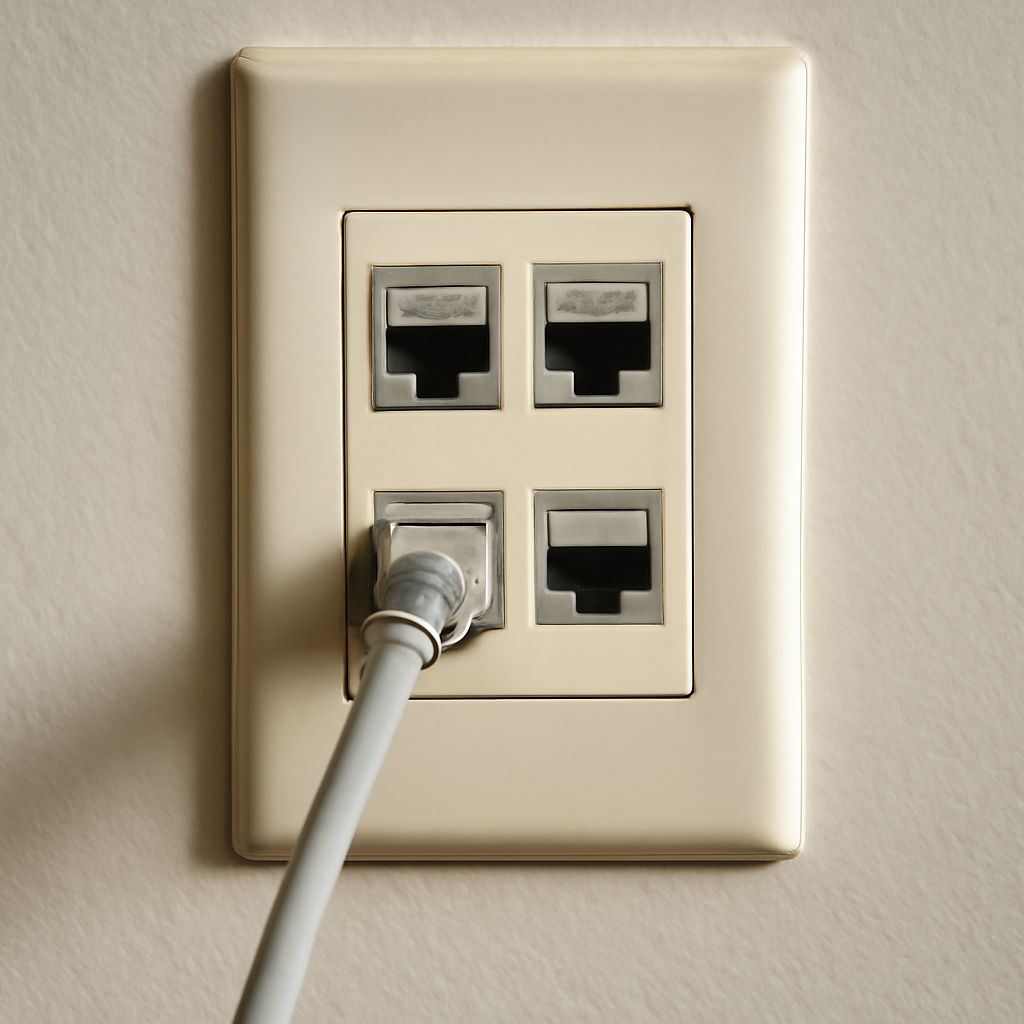
When setting up a network at home or in the office, understanding the differences between Ethernet and phone jacks is crucial. While both are common in telecommunications, they serve different purposes and offer distinct functionalities. This guide will highlight the key differences between Ethernet and phone jacks, compare Ethernet cables to phone cables, and outline when to use Ethernet over a phone connection.
What are the main differences between Ethernet and phone jacks?
Ethernet and phone jacks differ primarily in their design, function, and usage. An Ethernet jack, often referred to as an RJ45 connector, is designed for high-speed data transmission. It is commonly used for connecting computers, routers, and other network equipment to a local area network (LAN). In contrast, a phone jack, typically called an RJ11 connector, is intended for voice communication and connects telephones to landline services.
The connector size and pin configuration are notable differences. Ethernet jacks have eight pins, allowing for faster data transfer speeds and are compatible with Ethernet cables. Phone jacks, on the other hand, have four or six pins, which are sufficient for transmitting voice signals but not suited for high-speed data transfer.
How do Ethernet cables compare to phone cables?
Ethernet cables, such as Cat5e, Cat6, or Cat7, are specifically designed to handle higher bandwidths and faster speeds compared to phone cables. These cables consist of twisted pairs of wires that minimize interference and enhance the quality of data transmission. They are suitable for connecting devices to a network and facilitating internet access.
In contrast, phone cables are constructed to carry voice signals. They typically include fewer wire pairs, often just one or two, which is adequate for voice communication but limits their ability to support data-intensive applications or high-speed internet connections.
The insulation and shielding of Ethernet cables are more robust than phone cables, which helps in reducing electromagnetic interference and maintaining signal integrity over longer distances. This makes Ethernet cables the preferred choice for networking and internet purposes.
When should you use Ethernet over a phone connection?
Choosing between Ethernet and a phone connection depends on your specific needs. Ethernet is the optimal choice when you require high-speed internet access, reliable data connections, or are setting up a home or office network. It is particularly beneficial for activities such as streaming, online gaming, or transferring large files, where speed and stability are crucial.
In scenarios where only voice communication or basic landline functionality is needed, a phone connection is sufficient. This is typical in environments where internet speed is not a priority, or where the infrastructure does not support Ethernet connectivity.
Overall, if your primary goal is to establish a robust and high-speed data network, opting for Ethernet over a phone connection is advisable. However, for simpler applications requiring only voice transmission, a phone jack connection may be suitable.