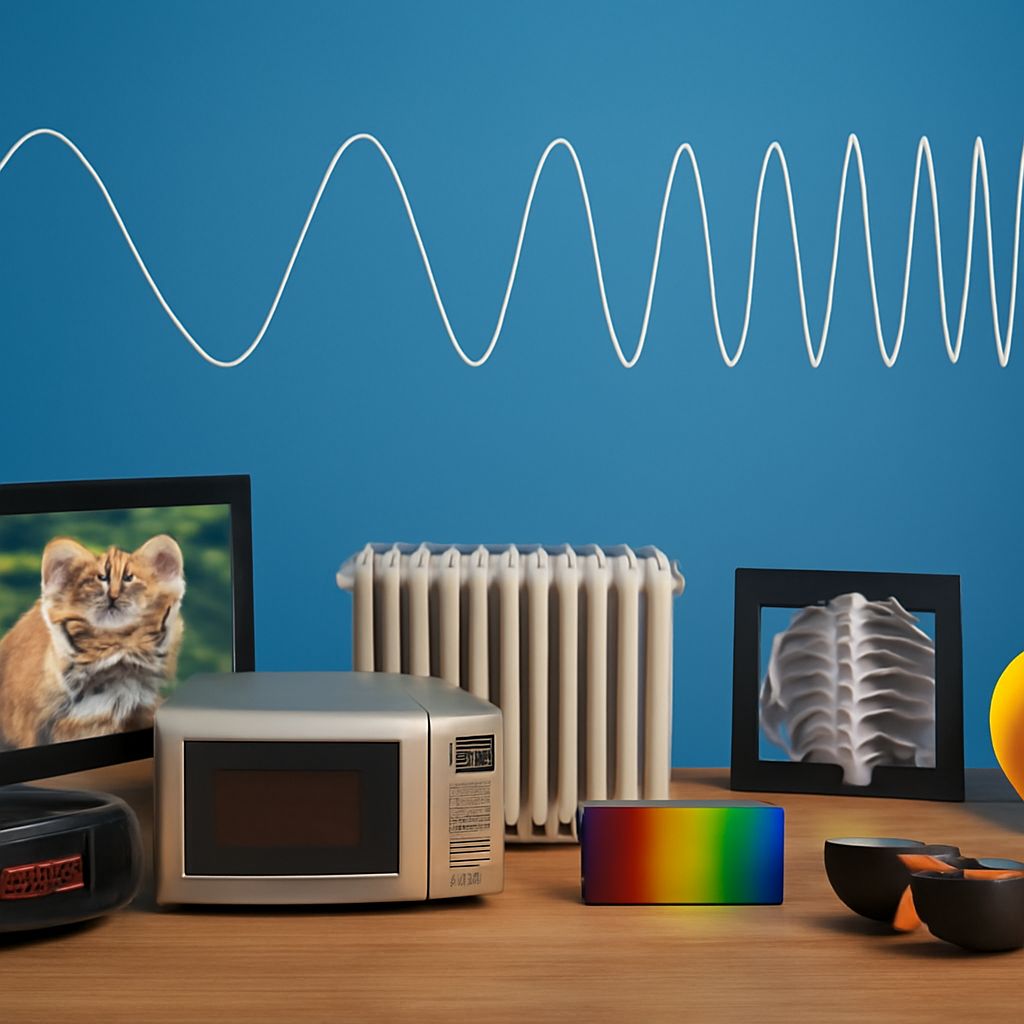
A Wi-Fi router and an FM station both send information through the air, yet a phone cannot receive an FM broadcast by joining the router’s network. They use different parts of the radio spectrum and different signaling systems. Understanding the frequency of a radio wave explains part of that difference; bandwidth, antennas, and the receiver complete the picture.
What Is Radio Frequency and How Is It Measured?
A practical radio frequency definition starts with repetition: frequency is the number of cycles an electromagnetic wave completes each second. One cycle per second is one hertz (Hz). Thousands of hertz are kilohertz (kHz), millions are megahertz (MHz), and billions are gigahertz (GHz). For example, 100 MHz means 100 million cycles per second.
What is radio frequency in a wireless system? It identifies where a signal lies in the radio portion of the electromagnetic spectrum. A transmitter varies a radio wave to encode information, and a receiver designed for that signal extracts it. The variation is called modulation. Frequency is one part of the specification: two systems operating near the same frequency can still use incompatible modulation or channel arrangements.
RF, radio frequency, is the abbreviation commonly used for this part of the spectrum and the signals associated with it. Radio frequencies cover a broad range, from long waves used for specialized services to much shorter waves used in microwave links. The National Telecommunications and Information Administration describes frequency bands and the units used to measure them.
Frequency and wavelength
What does the frequency of a radio wave tell you about its size? Wavelength is the distance between corresponding points on successive cycles of a traveling wave. In free space, divide the speed of light by frequency to find it. As frequency rises, wavelength becomes shorter. A wave at about 100 MHz has a free-space wavelength of roughly 10 feet; at 2.4 GHz it is about five inches.
This relationship matters for antennas. An antenna’s dimensions and design relate to the wavelengths it is intended to send or receive. An FM broadcast antenna and a compact Wi-Fi antenna therefore have very different practical sizes. Antennas can use coils, ground structures, and other design techniques, so their physical length need not equal one full wavelength.
The frequency of a radio signal is not its strength. Frequency describes the rate of oscillation; received strength depends on transmitted power, antenna characteristics, distance, obstacles, and other losses. A receiver may tune the correct channel and still struggle if the desired signal is too weak or interference is too strong.
What happens along the path?
Radio waves spread, reflect from surfaces, and lose strength as they travel. Buildings, terrain, trees, and even people can change reception. Reflected copies of the same signal can arrive at different times and combine constructively or destructively; this is called multipath. A small change in device or antenna position can therefore change the result.
What does a radio signal’s frequency mean for coverage? It influences how the signal interacts with obstacles and the environment, but does not determine coverage on its own. Lower-frequency signals may penetrate some obstacles better, while higher frequencies can offer access to wider channels and compact antennas. Transmit power, antenna placement, local interference, and the system’s design matter in both cases.
For a television antenna, aim and placement can improve the wanted broadcast relative to reflections and noise. For Wi-Fi, moving the router into the open and away from dense obstructions may improve coverage. A cellular device also depends on the distance and path to its serving site, not simply the number printed beside a band.
Bands, channels, and bandwidth
How do frequencies organize radio communication? A band is a range of frequencies. A channel is an assigned portion used by a particular system; its width is its bandwidth, measured in hertz. That width is different from network throughput, which is data delivered per second. A wider channel can support a higher data rate under suitable conditions, but signal quality, modulation, interference, and sharing also affect the result.
Think of an FM station, a mobile network, and a Wi-Fi access point as three systems using different allocations and technical rules. A receiver must support the relevant band and signaling method. The US spectrum is managed for different uses, with licensing or operating conditions depending on the service and equipment. A frequency number alone does not grant permission to transmit on it.
Nearby signals can interfere when receivers cannot adequately separate them. The remedy depends on the source: changing a Wi-Fi channel may help with local congestion, while a broadcast reception problem may call for a different antenna position or a better connection. First identify the affected service, band, and time before changing equipment.
Can one antenna receive every signal?
An antenna can cover a range of frequencies, but its useful range depends on its design and the receiver attached to it. For a specific task, select an antenna rated for the service and frequencies you need, then consider placement, cable loss, and the signal path. Matching those parts gives the receiver a better chance to use the signal available at your location.