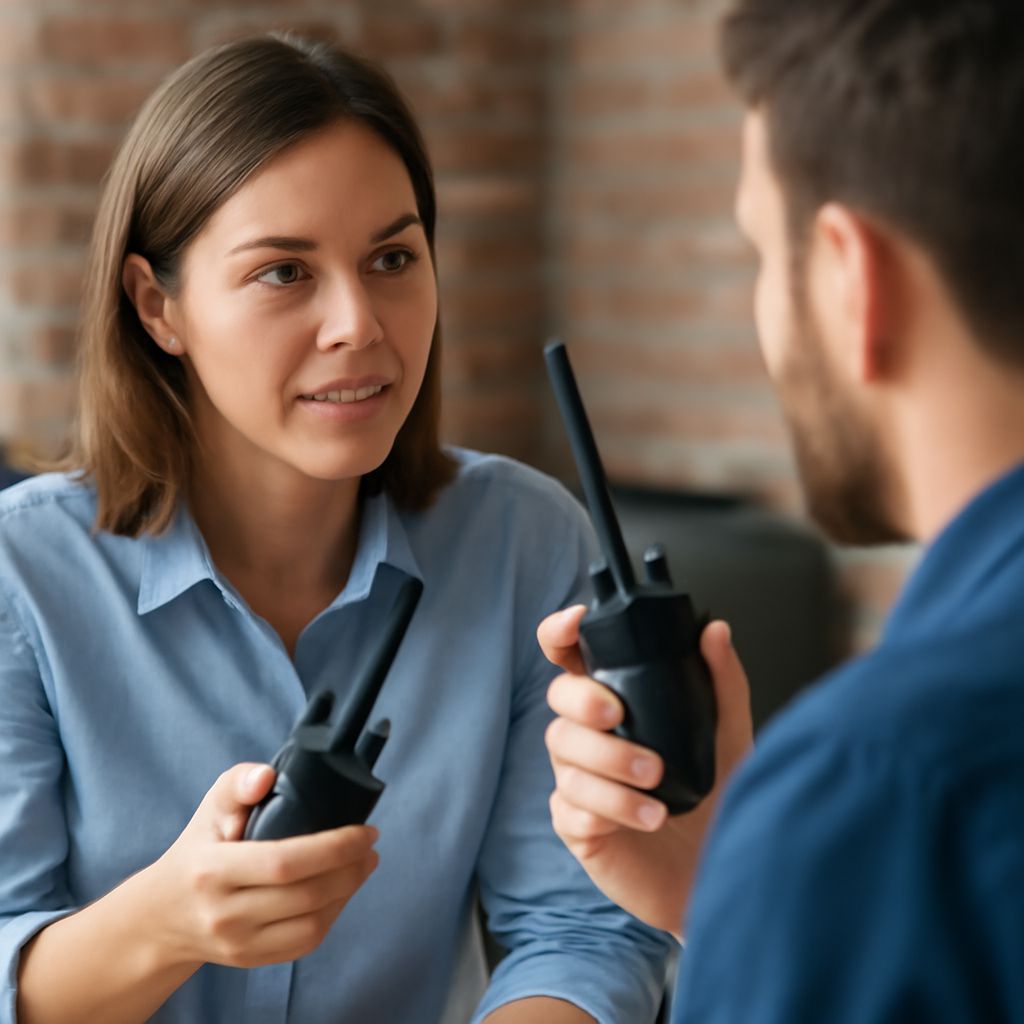
Call the person you want, identify yourself, and give a short message. Say “over” when you expect a reply and “out” when the exchange is finished. The language used on walkie talkies is easier to learn when everyone agrees on the words; codes used with walkie talkies can mean different things to different groups.
Make the first call
Most handheld radios use push-to-talk: hold the button while speaking and release it to listen. On a shared channel, only one person can normally be understood at a time. Listen first; if someone is already speaking, wait for a pause. Press the button, pause briefly so the beginning is not clipped, then speak clearly at a normal pace.
Good walkie talkie lingo starts with a name. Simple walkie talkie phrases make each turn easier to follow. Address the person you want, then identify yourself: “Sam, this is Alex. Are you at the north entrance? Over.” Sam knows who is being called, who is calling, and that an answer is expected. Use the identification required by your radio service or organization; a first name in this example is just a convenient label for a practice group.
If the message is long, divide it into short parts and leave space for a reply. A listener who missed a location can ask for it again before the conversation moves on. Keep the microphone a short distance from your mouth and avoid shouting, which can make speech harder to understand.
Know when to listen and when to finish
Two short words give each turn a clear boundary:
- Over: “I have finished transmitting and expect a response.” Release the button and listen.
- Out: “The conversation is finished; no response is expected.” Release the button after saying it.
Saying “over and out” combines opposite expectations. Choose the one that fits the moment. Rhode Island’s emergency radio procedures make this distinction explicit.
A complete exchange can be brief:
- Alex: “Sam, this is Alex. Are you at the north entrance? Over.”
- Sam: “Alex, this is Sam. I’m at the north entrance. Over.”
- Alex: “Copy, north entrance. Alex out.”
In this example, “copy” acknowledges receipt, and repeating the location checks the detail that matters. For an instruction involving a time or destination, repeat those details back rather than relying on a bare acknowledgment. If the signal breaks up, say which part you missed and ask for a repeat.
Walkie talkie codes and plain language
Some teams use radio codes on walkie talkies to save time. The trouble is that walkie talkie codes do not have one universal meaning. An organization may define a number or phrase differently from another organization. Even familiar codes for walkie talkies should be checked against the local list. FEMA’s incident management training recommends plain language rather than organizational 10-codes when multiple organizations work together.
Before using walkie talkie codes, learn the list adopted by your team and the procedures for your radio service. Ask which walkie talkie radio codes the group actually uses, and what each one means. When working with people who do not share that list, say the message in plain language: “The delivery has arrived at the north entrance,” for example. Clear words let the other person act without guessing at a number.
The lingo of walkie talkies can still include concise procedural words. “Say again” asks for a repeat; “stand by” asks the other operator to wait. Agree on these terms beforehand, and explain anything that is unfamiliar. Radio shorthand for walkie talkies helps only when both ends attach the same meaning to it.
Separate spoken terms from radio settings
A “code” on a radio’s display may refer to a squelch setting, not something you say. A compatible tone or digital squelch setting can keep a receiver quiet until it detects the selected signal. Both radios need compatible channel and squelch settings for that feature to work as intended. These codes in walkie talkie menus control receiver filtering rather than conveying a spoken message. The setting does not make a shared channel private: other users on the frequency can still hear transmissions with suitable equipment.
If you cannot hear a teammate, compare the channel, any tone or digital squelch setting, volume, and power. Check that the radios use compatible frequencies and radio services. Then try again from nearby with a clear path between you. If the short-range test works but a distant one fails, terrain, buildings, or distance may be affecting the signal.
Make practice count
Walkie talkie talk should carry a useful message, not just sound official. Choose one detail worth confirming, such as a meeting location, and ask the recipient to repeat it. That simple check exposes a misunderstanding while there is still time to correct it.
Your walkie talkie lingo should fit the people listening. The terms used in walkie talkie conversations should be familiar to the whole group. For a family outing, ordinary names and plain directions may be enough; an organized event may have its own operating procedure. Either way, a message is complete only when the intended listener can understand what to do with it.
To practice walkie talkie language now, make one short call to a partner on an authorized channel, ask for a location, and finish with “over”; have your partner answer, then acknowledge the location and say “out.”