The spectrum of electromagnetic radiation extends continuously from long radio waves to short gamma rays. It includes the signals used by antennas and Wi-Fi, as well as the visible light reaching your eyes. To understand what the electromagnetic spectrum is, follow one relationship: as wavelength gets shorter in a vacuum, frequency and the energy of each photon increase.
What Is the Electromagnetic Spectrum?
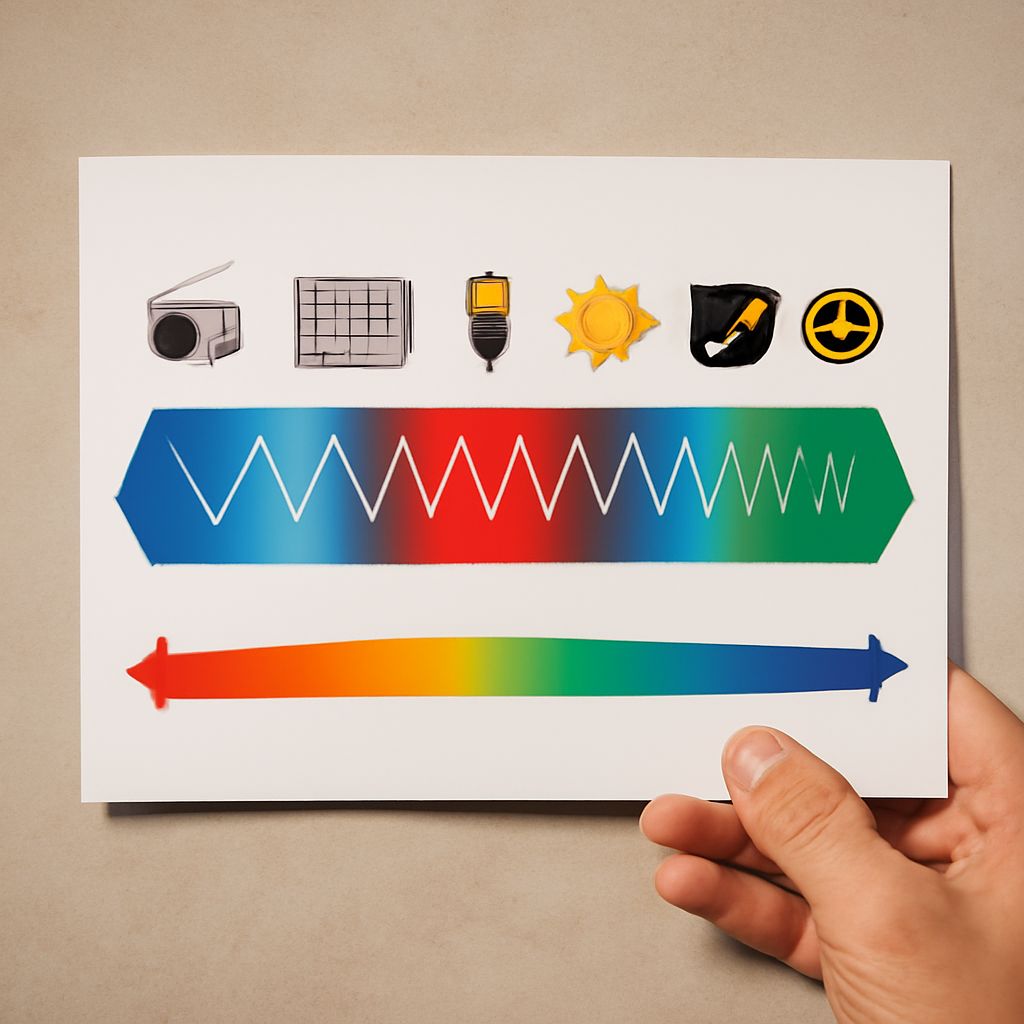
Imagine a scale arranged by frequency, the number of wave cycles passing a point each second. What is the electromagnetic spectrum? It is that scale for electromagnetic radiation, covering radio, microwave, infrared, visible, ultraviolet, X-ray and gamma-ray regions. The boundaries are approximate conventions; the scale has no empty slots between its named regions. Microwaves are often treated as a subset of radio waves.
A transmitter and a lamp may look unrelated, yet both send energy through changing electric and magnetic fields. The electromagnetic radiation spectrum organizes that radiation by measurable properties rather than by the device producing it. What the spectrum of electromagnetic radiation shows is how those regions relate. A radio receiver responds to a selected range of frequencies; the eye responds to a small range of visible wavelengths.
Three ways to describe the same wave
Wavelength is the distance between successive matching points on a wave, such as two crests. Frequency, measured in hertz (Hz), counts cycles per second. In a vacuum, their product is the speed of light: about 186,000 miles per second. Double the frequency and the wavelength halves. In a material, the wave speed and wavelength can change while its frequency stays the same at the boundary.
Radiation also comes in packets called photons. Each photon’s energy equals its frequency multiplied by Planck’s constant. A higher-frequency photon carries more energy. That is different from signal strength: a stronger beam can deliver more energy through more photons without changing the energy of each one. NASA’s wave overview explains these relationships.
The electromagnetic wave spectrum can therefore be labeled in frequency, wavelength or photon energy. The choice depends on the job: radio engineers often use frequency, while visible light is commonly described by wavelength. Once you know what the spectrum of electromagnetic radiation represents, those labels become different coordinates for the same radiation.
From a broadcast antenna to visible light
Moving through the regions toward higher frequency, each region offers different ways to produce and detect radiation:
- Radio: Alternating electric currents in a transmitting antenna generate radio waves; a receiving antenna converts part of the incoming field into an electrical signal. Broadcast TV and radio use selected radio frequencies. Buildings, terrain and antenna placement affect reception. Radio occupies a broad portion of the spectrum of electromagnetic waves.
- Microwave: Wi-Fi and microwave ovens use frequencies in this part of the EM wave spectrum; EM means electromagnetic. An oven produces microwaves that transfer energy to food, including through interactions with water molecules. A Wi-Fi receiver instead detects a much weaker signal carrying information.
- Infrared: Warm objects emit infrared radiation. A thermal camera detects some of that emission and converts it into an image. Many molecules absorb particular infrared frequencies associated with their vibrations, so absorption depends on the material and wavelength.
- Visible: The Sun and lamps emit light that reaches the eye or a camera sensor. A surface may absorb some wavelengths and reflect others; the reflected light helps determine its apparent color. Visible wavelengths occupy only a narrow part of the spectrum of electromagnetic radiation.
Waves across these regions interact with matter in different ways. These examples show why understanding what the electromagnetic spectrum means helps explain device behavior. A wall that blocks much visible light may still let some radio energy through, while metal can reflect radio waves. The outcome depends on frequency, material, thickness and geometry. Antennas and sensors must be designed for the frequencies they are meant to receive.
Beyond violet
Ultraviolet (UV) lies beyond visible violet at higher frequencies. The Sun emits UV, and specialized sensors can detect it. Some UV photons can trigger chemical changes, including reactions in skin; effects depend on wavelength and exposure.
X-rays have still higher photon energies in the usual ordering. In medical imaging, an X-ray tube produces radiation that passes through the body to a detector. Different tissues absorb different amounts, creating image contrast. Gamma rays can arise in nuclear processes and are detected with specialized instruments. X-rays and gamma rays can overlap in energy, and their names may also reflect how they were produced.
At these higher energies, photons can ionize atoms: they can remove electrons. This interaction is one reason exposure is managed in medical and other settings. Whether radiation is absorbed, transmitted or scattered depends on both its energy and the material it encounters. The NASA spectrum guide places these regions in order and compares their photon energies.
A quick comparison you can use
The spectrum of electromagnetic radiation connects familiar signals to light through the same rule. A 100 MHz FM radio wave has a vacuum wavelength of about 118 inches. A 2.4 GHz Wi-Fi wave has a wavelength of about 4.9 inches: its frequency is 24 times higher, so its wavelength is 24 times shorter. Visible light has much higher frequencies and still shorter wavelengths. For any two such waves, compare frequencies first: the higher-frequency wave has the shorter vacuum wavelength and higher photon energy.