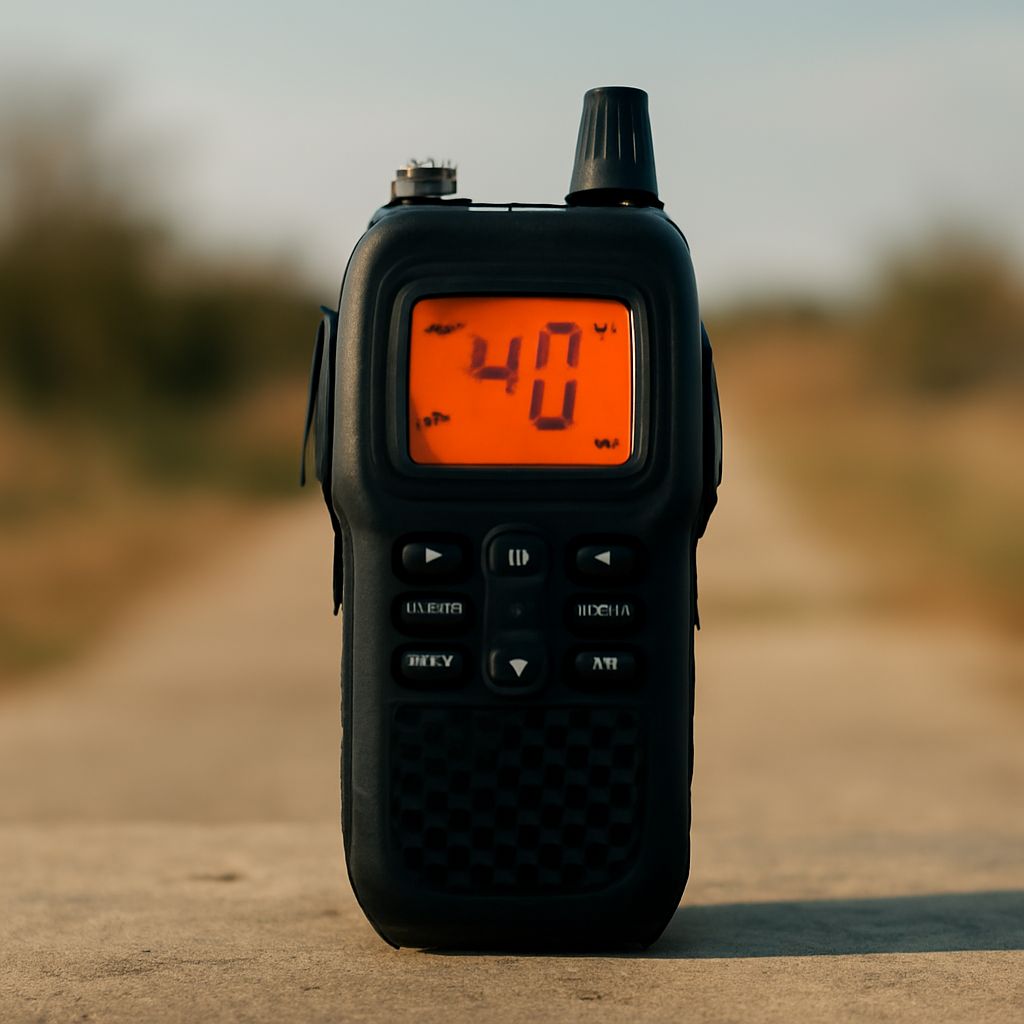
SSB CB radio range depends less on a guaranteed mileage figure than on signal mode, antenna efficiency, feed-line loss, terrain, and propagation. Single sideband can make a weak signal easier to copy and can extend practical contacts, but it cannot overcome a poor antenna or blocked path.
The same principle applies to audio: a suitable CB radio microphone, correct wiring, and careful gain adjustment can make an SSB contact clear without increasing the radio’s RF output.
How Does SSB Work on CB, and What Affects SSB CB Radio Range?
AM transmits a carrier plus two sidebands. SSB removes the carrier and one sideband, sending only the information needed to reproduce speech. That narrower signal uses roughly 2.5 to 3 kHz of occupied bandwidth, while a conventional AM CB signal uses considerably more bandwidth around its carrier.
Because the SSB transmitter concentrates power in one sideband instead of spreading it across a carrier and two sidebands, a receiving station can often copy speech at a lower signal level. This is the main reason SSB can improve practical range and intelligibility. It does not create extra antenna height, eliminate obstacles, or guarantee a particular distance.
- Match the mode: Both stations must use SSB, and both must select the same sideband, usually upper sideband (USB) or lower sideband (LSB).
- Tune carefully: SSB has no continuously transmitted carrier for automatic tuning. A station slightly off frequency sounds distorted, too high, or too low until the receiver is tuned accurately.
- Use compatible channels: SSB CB radios generally use the same numbered CB channels as AM radios, but an AM-only radio will not correctly receive an SSB voice signal. Follow the channel plan and avoid interfering with existing contacts.
On a clear day with line-of-sight conditions, SSB may provide a modest improvement over AM. During atmospheric skip, however, signals can travel hundreds or thousands of miles, while local stations may fade or become difficult to hear. That is propagation, not a dependable everyday range specification.
What Controls SSB Range: Antenna, Feed Line, Power, Terrain, or Propagation?
The antenna system usually has more influence than changing between similar radios. A full-size quarter-wave mobile antenna, such as a properly installed 102-inch whip, generally performs better than a shortened antenna with heavy loading. Mount the antenna where its radiation pattern is not blocked by a vehicle body, roof, cargo, or nearby metal.
For a base station, antenna height and a clear view matter. Ground-plane design, radial layout, and installation quality affect how efficiently power becomes a radio wave. Check the antenna with an SWR meter or the radio’s built-in meter, but remember that low SWR alone does not prove that an antenna is efficient.
Use good-quality coaxial cable with sound connectors and keep the run no longer than necessary. Water ingress, crushed cable, corroded connectors, and sharp bends add loss. Power can help a marginal path, but extra transmitter power cannot compensate for a badly matched or inefficient antenna and may be restricted by applicable CB rules.
Terrain also sets the practical limit. Hills, buildings, dense forests, and the vehicle’s position can block or weaken a signal. Ground-wave contacts are usually more predictable than skip contacts. Propagation changes with solar activity, time, season, and frequency conditions, so judge range by repeated contacts from the same setup rather than by one exceptional report.
How Do You Choose, Wire, and Adjust a CB Radio Microphone?
Choose a microphone that matches the radio’s connector wiring and electrical requirements; CB microphone plugs are not wired identically across brands. A replacement mic can have the wrong transmit, receive, ground, or audio pins even when the plug physically fits. Use the radio manual or a verified wiring diagram, and install an adapter when appropriate rather than guessing.
- Dynamic microphones are rugged and often handle loud voices well.
- Electret or amplified microphones can provide strong, detailed audio but require compatible bias or power and may overdrive a sensitive radio.
- Noise-canceling microphones are useful in vehicles with engine, road, or fan noise, especially when held close to the mouth.
Set the microphone gain conservatively. Hold the mic about 2 to 4 inches from your mouth, speak across rather than directly into the element, and use a normal voice. Excessive gain, shouting, echo, or compression can produce harsh SSB audio and splatter into adjacent channels. Gain increases audio drive; it does not directly increase antenna power.
Make a short test transmission and ask a nearby station for an audio report. If available, use the radio’s monitor function at low volume, but an external station is a better judge of the transmitted signal. Speak several sentences at normal volume, pause, and adjust gain until speech is full and intelligible without distortion.
What Do CB Radio Call Signs and Handles Mean on Air?
Most CB operators use an informal handle, such as “Blue Pickup” or “Mountain Runner,” to identify themselves on air. A handle is chosen by the operator or given by a group; it is not an officially issued amateur-radio call sign. Operators may casually call these identifiers “CB radio call signs,” but that usage does not make them assigned credentials.
Use a handle consistently during a contact: “Mountain Runner, this is Blue Pickup.” Add a location, signal report, or brief operating detail when useful. The NATO phonetic alphabet can clarify a difficult name or registration, but it does not turn a handle into a regulated identifier.
Assigned call signs belong to services and license systems that issue them, including amateur radio and certain aviation, maritime, and public-safety operations. Do not invent an amateur call sign format or imply that a personal CB handle was issued by a licensing authority. For a clean SSB contact, identify with your chosen handle, confirm the other station’s audio and signal, and keep transmissions brief enough to leave the channel usable.