What frequency is CB radio? In the United States, the Citizens Band (CB) service occupies 26.965–27.405 MHz across 40 fixed channels. Ham radio uses multiple amateur bands from low-frequency HF through VHF and UHF, while the AM radio frequency range is 535–1705 kHz for U.S. broadcast service.
These services organize frequencies differently. CB equipment selects numbered channels, amateur operators tune within allocated bands, and AM broadcast receivers tune to station channels. The ranges below use MHz for CB and amateur radio, and kHz for AM broadcasting.
What frequency is CB radio? Channel numbers and MHz spacing
CB channels are narrow, preset frequency assignments rather than one continuous tuning range. The 40 U.S. channels are:
- Channels 1–3: 26.965, 26.975, and 26.985 MHz.
- Channels 4–7: 27.005, 27.015, 27.025, and 27.035 MHz.
- Channels 8–10: 27.055, 27.065, and 27.075 MHz.
- Channels 11–15: 27.085, 27.105, 27.115, 27.125, and 27.135 MHz.
- Channels 16–22: 27.155, 27.165, 27.175, 27.185, 27.205, 27.215, and 27.225 MHz.
- Channels 23–25: 27.255, 27.235, and 27.245 MHz, respectively.
- Channels 26–40: 27.265, 27.275, 27.285, 27.295, 27.305, 27.315, 27.325, 27.335, 27.345, 27.355, 27.365, 27.375, 27.385, 27.395, and 27.405 MHz.
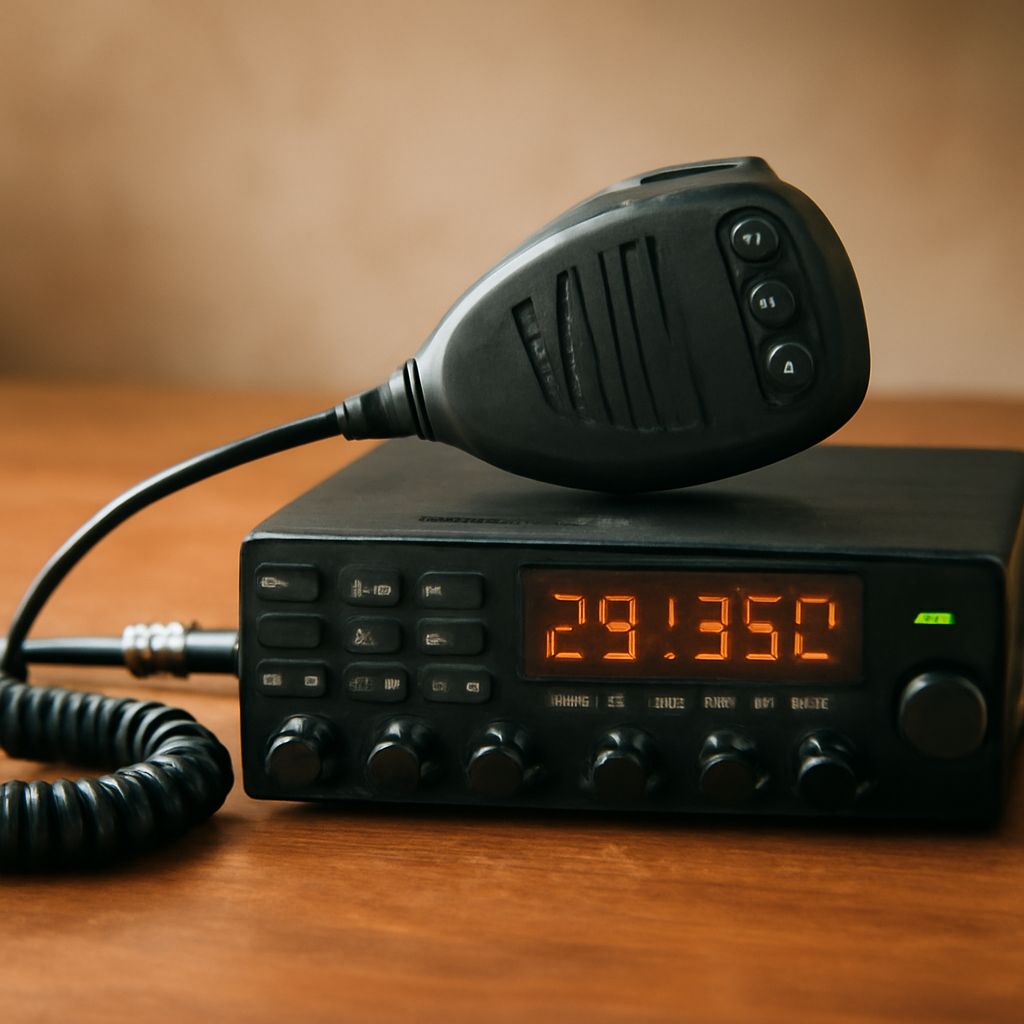
Most CB channels are separated by 10 kHz, but the channel plan includes gaps and the unusual ordering of channels 23 and 24. A CB transceiver is designed for this 27 MHz channel set and is commonly used for short-range vehicle, worksite, and local voice communication.
How does ham radio frequency vary by amateur band?
There is no single ham radio frequency. Amateur allocations are grouped into named bands, often identified by wavelength. The following are common U.S. reference ranges; privileges, modes, and exact allocations can depend on license class, national rules, and the band plan.
- 160 meters: 1.800–2.000 MHz.
- 80 meters: 3.500–4.000 MHz.
- 60 meters: designated channels near 5.3305, 5.3465, 5.3570, 5.3715, and 5.4035 MHz.
- 40 meters: 7.000–7.300 MHz.
- 30 meters: 10.100–10.150 MHz, with restricted operating modes.
- 20 meters: 14.000–14.350 MHz.
- 17 meters: 18.068–18.168 MHz.
- 15 meters: 21.000–21.450 MHz.
- 12 meters: 24.890–24.990 MHz.
- 10 meters: 28.000–29.700 MHz.
- 6 meters, 2 meters, and 70 centimeters: 50–54 MHz, 144–148 MHz, and approximately 420–450 MHz.
Unlike CB, an amateur transceiver often tunes across part or all of an authorized band. Operators select frequencies for voice, digital communication, or other permitted modes, so the allocation is broader than any one channel.
What is the AM radio frequency range? U.S. broadcast tuning in kHz
The AM radio frequency range for standard U.S. broadcast service is 535–1705 kHz, or 0.535–1.705 MHz. Those are the band edges. Receivers tune to station carrier frequencies centered on 10 kHz channel steps, normally from 540 kHz through 1700 kHz.
- Band: 535–1705 kHz.
- Typical channel centers: 540, 550, 560, and continuing in 10 kHz steps through 1700 kHz.
- Equipment: an AM broadcast receiver selects one-way station transmissions; it is not a two-way CB or amateur transceiver.
How do CB, amateur, and AM broadcast ranges differ in use and equipment?
A shared spectrum scale shows why the services should not be treated as interchangeable:
- AM broadcast: 0.535–1.705 MHz, a continuous broadcast band in the low-frequency portion of the spectrum.
- CB: 26.965–27.405 MHz, a compact 27 MHz allocation divided into 40 numbered channels.
- Amateur radio: multiple separated allocations, including bands from 1.8 MHz through 450 MHz in the examples above.
A CB radio is built around fixed 27 MHz channels and short-range two-way use. A ham radio may be a single-band or multiband transceiver with variable tuning, but the operator must stay within the applicable amateur allocation and operating privileges. An AM radio is primarily a receive-only tuner that selects broadcast stations by their channel frequencies. A frequency appearing near another service’s range does not grant permission to use that service’s channels or substitute one type of radio for another.