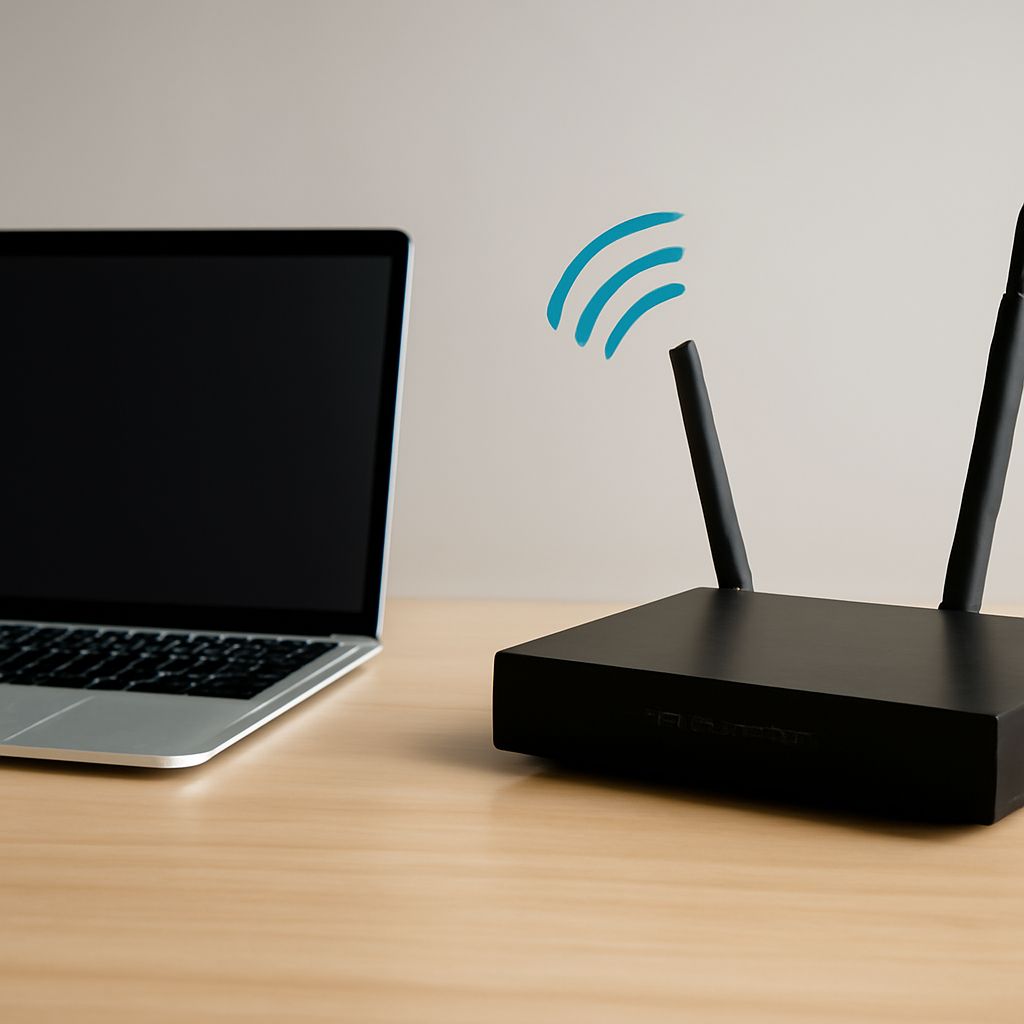
What’s the difference between 2.4 GHz and 5 GHz Wi-Fi? The 2.4 GHz band reaches farther and usually passes through walls more effectively, while 5 GHz typically delivers higher speeds at shorter distances. The better choice depends on the device’s location, obstacles, nearby networks, and whether the device supports both bands.
If you are asking, what is the difference between 2.4 GHz and 5 GHz, use 2.4 GHz for distant or low-bandwidth devices and 5 GHz for nearby devices that need faster connections. A dual-band router should normally keep both available rather than forcing every device onto one band.
What’s the Difference Between 2.4 GHz and 5 GHz Wi-Fi at a Glance?
Both bands connect devices to the same local network, but they use different radio frequencies. Their practical differences are:
- Range: 2.4 GHz generally covers more distance than 5 GHz.
- Wall penetration: 2.4 GHz usually loses less signal through walls, floors, and furniture.
- Channels: 5 GHz commonly provides more channels and wider channel options, while 2.4 GHz has fewer usable channels.
- Congestion: 2.4 GHz is often busier because it is used by older Wi-Fi equipment, Bluetooth devices, and some household electronics.
- Speed and capacity: 5 GHz can support faster connections and more usable bandwidth nearby, but its advantage decreases as the signal weakens.
- Compatibility: Most current phones, computers, streaming devices, and routers support 5 GHz, while some older or inexpensive smart-home devices support only 2.4 GHz.
In practical terms, choose 5 GHz for a nearby television, game console, laptop, or streaming box. Choose 2.4 GHz for a camera, sensor, or smart plug located far from the router.
Which Band Offers Better Range and Wall Penetration?
2.4 GHz offers better range because its lower-frequency signal generally travels farther and retains more strength through common household obstacles. It is usually the more reliable option when a device is several rooms away, on another floor, or outside near the edge of the router’s coverage.
5 GHz has shorter effective range and loses signal more quickly through dense materials such as concrete, brick, and multiple walls. In the same room or an adjacent room, however, it can provide an excellent connection. If a 5 GHz device shows a strong signal, its shorter range is not a disadvantage.
Distance should therefore be judged at the device’s actual location, not from the router’s advertised maximum range. A 2.4 GHz connection with a strong signal can outperform a weak 5 GHz connection, even though 5 GHz has a higher potential data rate.
How Do Channels, Congestion, and Interference Compare?
2.4 GHz has limited channel space. In many regions, only three 20 MHz channels can operate without overlapping. Nearby routers may therefore compete for the same small amount of spectrum. Bluetooth accessories, wireless cameras, baby monitors, and microwave ovens can add interference in this band.
5 GHz generally offers more channels and more room for wider channels, so it can handle busy wireless environments more efficiently. It is often the better choice in an apartment building, office, or other location with many nearby routers. Some 5 GHz channels may be subject to radar-detection rules, which can cause a router to change channels or make certain channels unavailable.
More channels do not eliminate interference. A distant 5 GHz signal may still perform poorly, and a clear 2.4 GHz channel may work well for a low-bandwidth device. Router placement, channel selection, and signal strength affect the result in both bands.
How Do Speed, Capacity, and Compatibility Guide the Choice?
5 GHz usually supports higher link speeds because it can use wider channels and has more available spectrum. It is well suited to high-throughput activities such as 4K streaming, large downloads, video calls, and wireless gaming when the device is close enough to maintain a strong signal.
2.4 GHz has lower maximum speeds in many setups, but basic smart-home devices rarely need much bandwidth. Its longer reach can make it the more dependable choice for a door sensor or smart plug, even when a nearby 5 GHz network appears faster in a speed test.
Why higher frequency does not guarantee a faster real connection
A higher frequency does not automatically mean a faster real connection. Speed depends on signal strength, distance, walls, channel congestion, router capability, client hardware, and the internet service entering the home. A weak 5 GHz signal may deliver less usable performance than a strong 2.4 GHz signal.
Device support matters too. A router may broadcast both bands, but a client with a 2.4 GHz-only radio cannot use 5 GHz. Some older devices also have trouble joining a combined network name, so checking the manufacturer’s requirements may be necessary.
Nearby media devices: choose 5 GHz when the signal is strong
Use 5 GHz for a streaming stick, smart television, console, or computer in the same room or nearby room. It usually offers more capacity and less congestion for high-bandwidth traffic. Switch to 2.4 GHz if thick walls or distance make the 5 GHz signal unstable.
Distant sensors: choose 2.4 GHz when reach matters
Use 2.4 GHz for outdoor cameras, garage sensors, smart plugs, and other distant devices that send small amounts of data. Confirm that the device supports the band and place the router or access point where it can reach the device without excessive obstruction.
Crowded networks: keep both bands available
On a crowded network, keep both bands enabled. Put high-throughput devices on 5 GHz when possible, while leaving 2.4 GHz for distant or incompatible devices. A single network name with band steering can simplify setup; separate names give you direct control when a device repeatedly chooses the less suitable band.