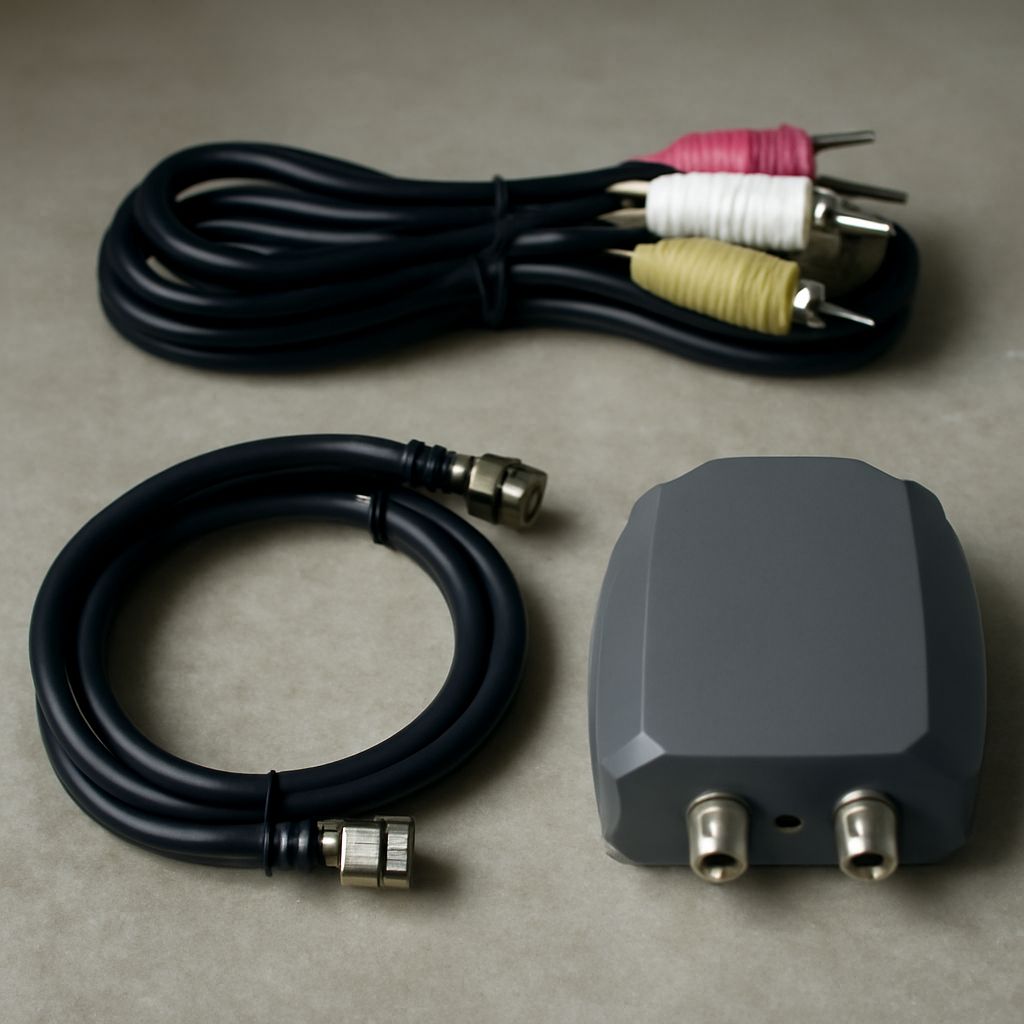
Choose a flexible coaxial cable by matching its impedance and signal frequency first, then check attenuation, power handling, shielding, bend radius, and connector fit. RG-58 and LMR families generally suit 50-ohm RF; RG-59 and RG-6 suit 75-ohm video and digital coax. A passive RCA to coaxial adapter changes the connector only. It cannot convert analog audio to digital audio, video to RF, or any other signal format.
An RCA plug identifies the connector style, not the signal carried through it. The same-looking RCA connection may serve analog audio, digital audio, composite video, component video, or an RF output, so identify the source and destination formats before choosing cable or an adapter.
How Does Flexible Coaxial Cable Balance Handling and Loss?
A coaxial cable has a center conductor, dielectric insulation, conductive shielding, and an outer jacket. Flexibility mainly comes from a stranded rather than solid center conductor, a smaller diameter, a softer dielectric, or a looser braid. These features make the cable easier to route repeatedly, but they can increase resistance, signal loss, or susceptibility to interference.
Short patch cables can usually prioritize handling. For a long run, high frequency, or higher transmit power, use a larger, lower-loss construction even if it is less pliable. A cable with foam dielectric and a carefully bonded foil shield often has lower attenuation than a very flexible cable of the same nominal size. Observe the manufacturer’s minimum static and repeated bend radii; sharply folding coax can change its impedance and damage the shield.
Which Types of Coaxial Cable—RG-58, RG-59, RG-6, or LMR—Fit Your Signal?
- RG-58: A compact 50-ohm cable, commonly about 5 mm in diameter, with a solid or stranded copper-family center conductor and braided shielding. It bends easily and works well for short antenna, radio, GPS, and test-equipment connections, but attenuation is relatively high as frequency or cable length increases.
- RG-59: A roughly 6 mm, 75-ohm cable used for composite video, CCTV, and some digital-audio links. Its solid center conductor and braid provide useful flexibility and moderate loss. Choose a version with a copper center conductor for power-carrying applications such as camera installations.
- RG-6: A larger 75-ohm cable, commonly 6.9 to 7.5 mm wide, with a solid center conductor and foil-plus-braid shielding. It normally has lower attenuation and better interference rejection than RG-59, making it suitable for long video, broadcast, satellite, and cable-TV runs. Its larger diameter makes tight bends harder.
- LMR: A family of low-loss 50-ohm cables, including compact LMR-195, mid-size LMR-240, and thicker LMR-400. Standard versions often use a solid conductor and double shielding, reducing attenuation and improving RF performance. LMR-240 and LMR-400 need more routing space; flexible or ultraflexible variants trade some loss and power capacity for easier installation.
How Do Impedance, Diameter, Conductors, Shielding, Attenuation, Bend Radius, and Connector Fit Affect Choice?
Use 50-ohm coax for most RF transmitters, antennas, and wireless equipment. Use 75-ohm coax for video and consumer digital audio. A mismatch may cause reflections, visible video problems, digital dropouts, or reduced RF power transfer, especially at higher frequencies. Impedance is determined by the conductor, dielectric, and shield geometry, not by the plug alone.
Larger diameter usually means lower attenuation, higher power handling, and a larger minimum bend radius. Solid copper conducts well and handles power effectively; copper-clad steel is common where lower cost matters but has greater resistance, especially at low frequencies. A braid provides flexibility, while foil improves high-frequency coverage. Dual shielding is preferable near transmitters, motors, or dense digital equipment.
Connector fit includes more than matching RCA, BNC, F, SMA, or N threads. The connector must suit the cable’s outside diameter, dielectric size, conductor, impedance, and termination method. A compression F connector designed for RG-6 will not correctly fit RG-59 or RG-58, and a connector rated for one frequency or power level may be unsuitable for another cable.
When Is an RCA to Coaxial Adapter Passive, and When Is Conversion Needed?
Use a passive adapter when the source and destination already use the same electrical signal format and only the connector changes. Examples include an RCA-to-BNC connection for compatible baseband video, or an RCA-to-BNC connection carrying 75-ohm digital audio when both devices expect coaxial S/PDIF. A passive adapter contains no power supply or processing; it provides contacts, shielding, and sometimes a short impedance-controlled connection.
- Analog audio: An RCA cable can carry left/right line-level audio. A passive connector adapter is sufficient when the receiving equipment accepts the same analog channel and level.
- Digital audio: Coaxial S/PDIF commonly uses a 75-ohm electrical link and an RCA-style connector. Use 75-ohm cable and compatible terminations; an RCA-to-BNC adapter does not make an analog input digital.
- Video: Composite and component video are normally 75-ohm signals and can use RCA connectors. A passive adapter can change the connector, but it cannot turn composite video into HDMI or another format.
- RF: An RCA-style RF output may connect to coaxial equipment through a passive adapter only when frequency, impedance, power, and connector ratings match. A television modulator or tuner is needed when the signal must be generated, demodulated, or reformatted.
Choose an active converter when the source and destination use different formats, such as optical digital audio to coaxial S/PDIF, analog audio to digital audio, composite video to HDMI, or baseband video to a modulated RF channel. These devices require power and perform actual signal processing; a connector-only RCA to coaxial adapter does not.