A listener close to a transmitter may hear it clearly with a small antenna by a window. Another listener behind a ridge may need a better outdoor position and a carefully chosen cable. Start with the frequencies you want, then compare antennas for your scanner by location, coverage, and the signal that actually reaches the receiver.
An antenna outside for a scanner can improve reception by escaping walls and household noise, but height and size are only parts of the system. The receiver, feed line, nearby transmitters, and local terrain all affect the result.
Start with the frequencies and receiver
List the services you want to hear and their frequencies in megahertz (MHz). Weather broadcasts, aircraft, amateur radio, and public-safety systems can occupy different bands. Check that the antenna’s stated coverage includes the specific frequencies, rather than assuming that a label such as “scanner” covers everything equally well.
A police scanner antenna can collect signals in a relevant band, but the radio must also support the system’s modulation and, where applicable, its digital and trunking format. Trunking is a system in which users share channels assigned by a controller. Consumer scanners cannot decode encrypted communications. Check the system and local rules before buying an antenna for a police radio scanner.
For one band, a purpose-built antenna may provide a more useful response there than a wideband design. If you want several distant bands, a broadband antenna trades some specialization for coverage. Published gain figures matter only with their reference, direction, and frequency; a single impressive number does not describe performance across an entire range.
Outdoor scanner antenna placement and tradeoffs
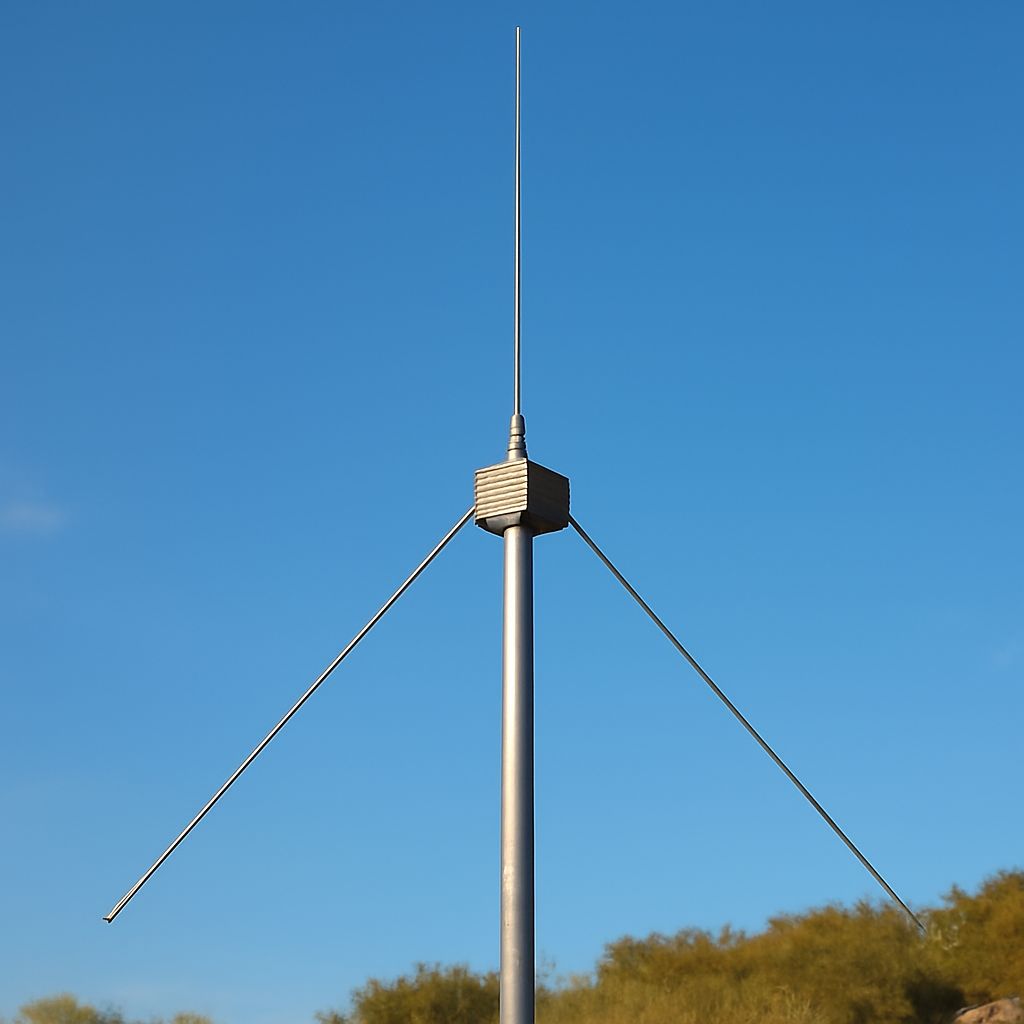
An outdoor scanner antenna can offer a clearer path over nearby obstructions and more separation from noise inside a building. It may also need a longer feed line, weatherproof connections, secure mounting, and proper grounding. Compare the signal at the radio after cable loss, not just the antenna’s advertised performance.
An indoor antenna costs less to install and is easy to move. Try it near a window, away from computers, power adapters, and LED lights. Building materials and nearby structures can block signals; moving the antenna a few feet can change reception. If the signal is already clear, an outdoor installation may add little value.
For an outdoor installation, keep the mast and antenna well clear of power lines, including anywhere they could reach if they fall. Arrange grounding and bonding to applicable local requirements and manufacturer instructions; use a qualified installer if needed. Never install or handle an outdoor antenna during a thunderstorm. The National Weather Service identifies power lines, falls, and lightning as installation hazards.
Choose coverage, direction, and cable
A radio scanner antenna intended for general listening often receives from many directions. A directional antenna concentrates its response toward a particular direction and can reduce some interference from elsewhere. That can help with one fixed, weak source, but it is less convenient when desired transmitters surround you.
Check polarization too. Many land-mobile signals are vertically polarized, so a vertical receiving element is a sensible first orientation. Signals reflected by buildings or terrain can arrive differently, making a small placement test worthwhile.
The coaxial cable carries the signal from the antenna to the radio and attenuates it along the way. Loss generally increases with cable length and frequency, so compare manufacturer loss specifications at your highest important frequency and planned length. Shorter, lower-loss cable can preserve a weak signal, although thicker cable may be harder to route and connect.
Check the antenna connector and the receiver’s input before ordering. BNC and SMA are common examples, but the correct type and mating end depend on the equipment. Use the proper adapter if needed, support a heavy cable so it does not strain a handheld radio’s socket, and seal outdoor connectors against water. Match the specified impedance where practical; many scanner inputs and antennas are designed around 50 ohms, though receive-only setups can tolerate some mismatch.
When more signal makes reception worse
A larger or higher antenna can collect stronger unwanted signals along with the one you want. Nearby broadcast or other transmitters may overload a receiver, producing false signals, distortion, or reduced sensitivity. More gain or an amplifier can make that overload worse.
If reception deteriorates after an upgrade, compare the old and new setups on the same channel. Temporarily reduce receiver gain or use its attenuator if available. Improvement with less input suggests overload; an appropriate filter ahead of the receiver can reduce a strong unwanted band. If both antennas hear mostly static, check cable connections, frequency coverage, location, and whether the desired service is actually transmitting.
An antenna for a police scanner should be selected for the actual local frequencies, not just the service name. Similarly, an outdoor antenna for scanning multiple radio bands needs useful coverage at each target frequency and a cable whose loss is acceptable at the highest one. A compact indoor antenna for a radio scanner may be the better choice in a strong-signal location with limited space.
Which setup should you choose?
For nearby signals on one band, begin with a suitable indoor or portable antenna and test its position. For several bands, choose a wideband model whose published range covers each one. For weak signals obstructed by the building, consider an exterior scanning antenna with a safe mounting point and a short, low-loss cable. Verify receiver compatibility first: a better signal cannot supply a missing decoder.