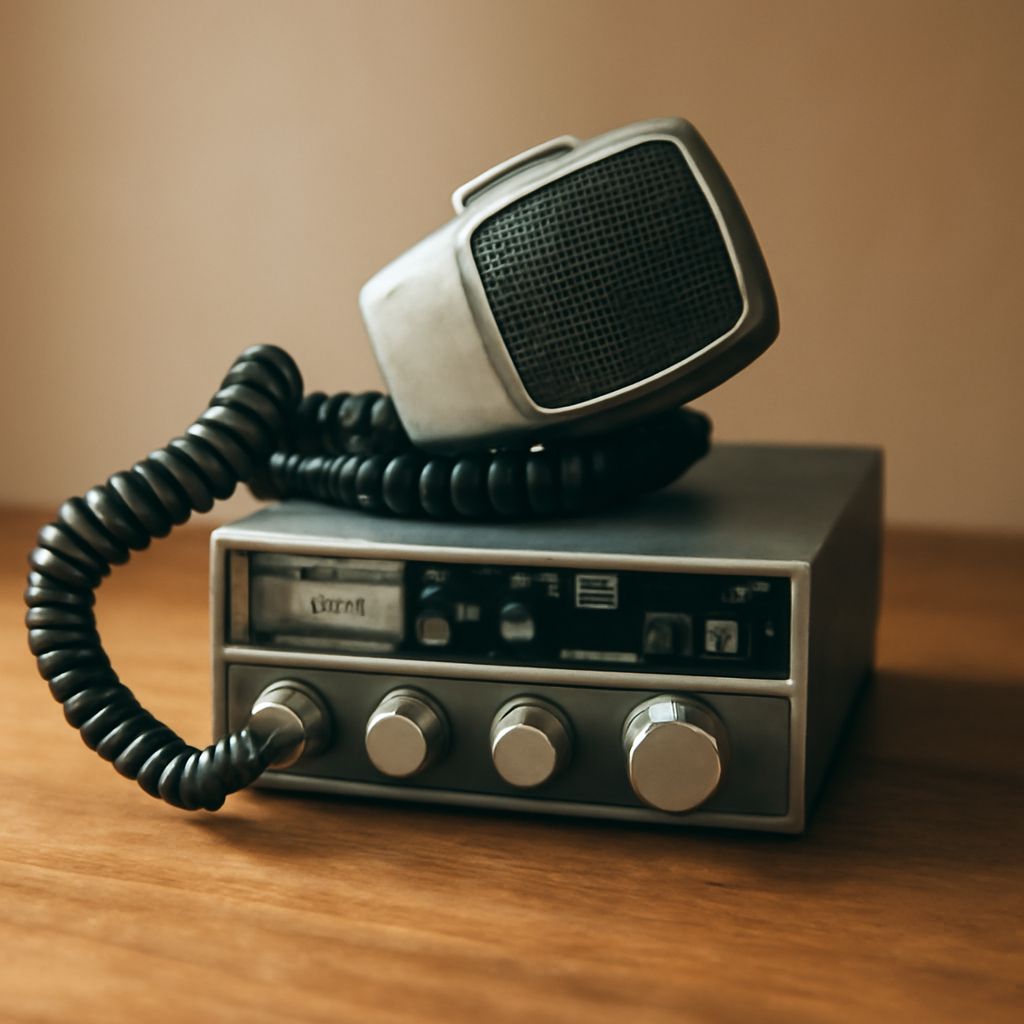
CB radio history helps explain why today’s service has 40 fixed channels, strict transmitter limits, and no general license application in the United States. A CB radio booster, however, can mean several different devices: a receive preamplifier, an external RF power amplifier, or marketing language for a better antenna. For most users, a CB radio license is not required; legal operation and a sound antenna system matter more than adding transmitter power.
Communication range usually improves first through antenna placement, tuning, grounding, and low-loss coaxial cable—not through a device advertised simply as a booster.
How did CB radio history shape today’s channelized service?
The FCC created the Citizens Radio Service in 1945, initially using frequencies around 460 MHz. In 1958, it established Class D operation in the 27 MHz band, which became the familiar citizens band. This lower-frequency allocation made practical mobile equipment possible and helped CB become popular with drivers, small businesses, hobbyists, and emergency-minded users.
The service originally had fewer channels. The FCC expanded it to the present 40-channel layout in 1977. Today’s CB channels occupy roughly 26.965 to 27.405 MHz, with AM and single-sideband equipment available. The channelized structure and operating limits are important: CB is a specific radio service, not a general authorization to transmit anywhere in the 11-meter band.
Do you need a CB radio license in the United States?
Under current U.S. FCC rules, most people do not apply for an individual CB radio license. CB operates under a license-by-rule system: using an FCC-certified CB transmitter in compliance with Part 95 rules supplies the authorization. You still must follow the service’s channel, power, equipment, and operating requirements.
The authorization applies where U.S. rules govern, including the United States and its territories and possessions. It is not an international license; operation in another country depends on that country’s radio regulations. A user also cannot turn a CB installation into a higher-powered station merely because no paper license is required.
For standard CB operation, the transmitter limit is 4 watts carrier power for AM and 12 watts peak-envelope power for single sideband. Those limits apply to the transmitter output, not to a seller’s claimed “boosted” range.
What is a CB radio booster, and how do preamps differ from power amplifiers?
“Booster” is an imprecise sales term. A receive preamplifier increases the level of incoming signals before they reach the receiver. It does not increase the transmitter’s legal output. A preamp can sometimes make a weak signal easier to hear, but it also raises noise and can overload the receiver when strong signals are present.
An external RF power amplifier, sometimes called a linear amplifier, increases transmitter output. That is a different function from receive gain and antenna gain. External RF power amplifiers are not permitted for CB operation under the FCC rules. They can also cause interference, distortion, and excessive stress on the radio or antenna system.
Antenna gain is different again. A passive antenna does not create power; gain describes how it concentrates radiation in particular directions compared with a reference antenna. On a mobile CB installation, a properly mounted and tuned antenna is generally a more useful improvement than either type of electronic “booster.”
How do antenna gain, tuning, placement, SWR, and feed-line quality affect CB range?
Start with the antenna system. A mobile antenna mounted near the center of a vehicle roof usually has a better ground plane and a clearer radiation pattern than one mounted low on a bumper or beside a metal obstruction. For a base station, height, clearance, and an appropriate ground-plane or radial system affect how effectively the signal leaves the antenna.
Tuning adjusts antenna length or its matching components so the radio sees a suitable load. Check the result with an SWR meter. A high SWR indicates a mismatch that can reflect power toward the transmitter and cause loss or equipment stress. A low SWR is desirable, but SWR alone does not prove that an antenna is efficient or has useful gain.
Feed-line quality matters between the radio and antenna. Use sound coaxial cable, correctly installed connectors, and the shortest practical run. Damaged cable, water intrusion, poor connectors, and unnecessary length add feed-line loss, reducing both transmitted signal and received signal.
- Improve antenna location and ground-plane performance before buying electronics.
- Tune the antenna after its final installation, not while it is temporarily mounted.
- Inspect coax and connectors if reception or transmission suddenly worsens.
With a normal mobile setup, dependable communication often means a few miles, while terrain, buildings, antenna height, and electrical noise can reduce that distance. A well-sited base antenna may reach farther. Atmospheric “skip” can produce very long contacts, but those signals are intermittent and do not replace a properly installed local antenna system.